
Something from the Bar?
This has to be the lamest question ever uttered, and it’s uttered a million times a day in restaurants all over the world.
It might elicit an actual drink order from a customer who always wants the same refreshment before dinner, but for everyone else it causes hesitation, confusion, reluctance, panic.
We don’t know what you have, how it’s priced, whether your bartender is frugal or licentious, which of the countless ways you might want to take advantage of us is in play . . . .
In other words, it creates an environment precisely the opposite of what the server intended, which was to make the customer comfortable, appreciated, and catered to (in a word, spendy).
Get it?

Here’s what your customer at Table 13 visualizes when you attack her with your demand that she order a drink:
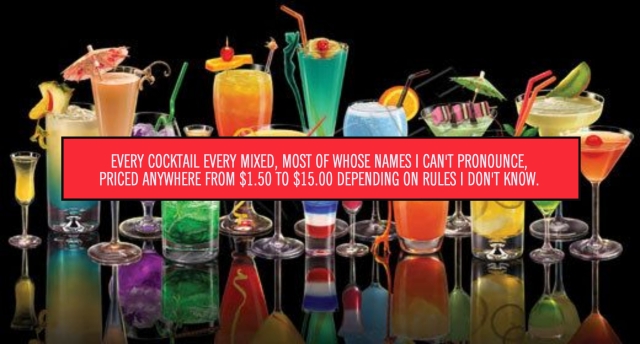
It’s no wonder that, when you make her select from this ridiculous array of alternatives—on a strict social deadline!—she panics in the moment and says the only safe thing: “I’ll stick with water.”
And you wonder why you don’t get bigger tips!
Hint to the metaphor: Readers do the same thing. Faced with too much new data or too many choices—in absence of clear guidance—they retreat to their bunkers where you can’t begin to persuade them.
How to Serve
You don’t understand your job, which is to serve, and by serving to guide, and by guiding to sell, and by selling to improve your employer’s bottom line, and—by helping out absolutely everybody—to take home bigger tips from happier customers whose enjoyment has been lubricated by expensive cocktails.
The best servers use their power to their advantage.
And when I say “servers” I mean “writers.” You understand this is an extended metaphor, right?
- They are the subject matter experts
- They have already examined the pertinent evidence
- They have come to the right conclusions
- If they establish your trust, they can guide you to the right conclusions
- Everybody is happy when you come to the right conclusions
How to Write
How to serve; how to write; they come down to the same set of rules. Stay in charge of the subject matter; approach it like the expert you are; guide your reader (diner) to the right conclusion.
One of the images below demonstrates the right way to offer up appetizers. The other is the way we write too often without even knowing we’re doing it.

Get it?
NOTHING is accomplished if I tell you “We have a wonderful assortment of delicious appetizers; what do you want?”
But if I extend to you a limited sampling of carefully selected delicacies (by which I mean data and evidence because we’re still talking about writing, remember?) and stand there smiling, offering by my benevolent presence to guide you through the options with pleasant but persistent patience, then we pretty much both understand you’re going to order one of these little beauties . . . probably the one on which the house earns the biggest markup.
Get it now?
Lessons from the Server
NOT TO DO
- Don’t ask open-ended questions.
- Don’t promise that you’ll have important information to share . . . later.
- Don’t blame the kitchen.
- Don’t apologize for what you don’t have.
- Never contradict your customer’s preferences.
TO DO
- Instead of open questions: We have spectacular cocktails from our certified mixologist (I know. I didn’t know there was such a thing either, but she has the certificate to prove it!
- But if you’re not drinking, I have flavored teas, a full line of soft drinks, fresh coffees and teas. I’ll even put a big bottle of sparkling water in a bucket of ice. (But I won’t let you think that “sticking with tap water” is an alternative.)
- Instead of saying there are countless options: For big appetites I have a 22-ounce porterhouse; South Jersey magazine raves about our chicken Parmesan; but the best bargain on the menu is the brick oven pizza: 15 bucks and you’ll take half of it home.
- Instead of blaming the kitchen: We’re not used to being so crowded on a Thursday, but the review that came out in the local paper has us really hopping.
- Instead of saying the owner forgot to order seafood: There are no good mussels in the market this week after that storm in the Gulf; fortunately, the Maine lobster was unaffected and the 2-pounder is on special.
- Instead of arguing about your customer’s favorite cut: A lot of people say that, and I agree, so this is hard for me to say, but the filet mignon actually has less flavor than the rib-eye which benefits from all the marbling. Our chef handles both cuts really well. Want to try something new?
Metaphorical Payoff
Do I really have to do this, or do you get it?
- THE KITCHEN is NOT the entire world of knowledge. It’s whatever you’ve been able to gather from your research. You’ve had just a few weeks, for crying out loud. It’s everything you could afford, and everything you could keep from spoiling in your limited refrigerator space (your White Paper; your Brain).
- THE CHEF is you back there working with dull knives and too little butter on the one working burner that isn’t devoted to all your other classes—the ones that really matter to your major!
- THE SERVER is also you. Once you graduate, you can hire someone to do the serving for you, but for now, you have to cook and deliver everything to the table.
- THE CUSTOMER is your reader. He’s an arrogant blowhard, full of opinions about what’s good and what’s bad about food. You have to figure out what he thinks he knows, charm him into questioning where he got that misinformation, and sell him that the Tortellini-Tre-P that he always thought was cruel to animals happens to be an ecological blessing in exactly three ways, which you delineate for him with pleasant and persistent patience.
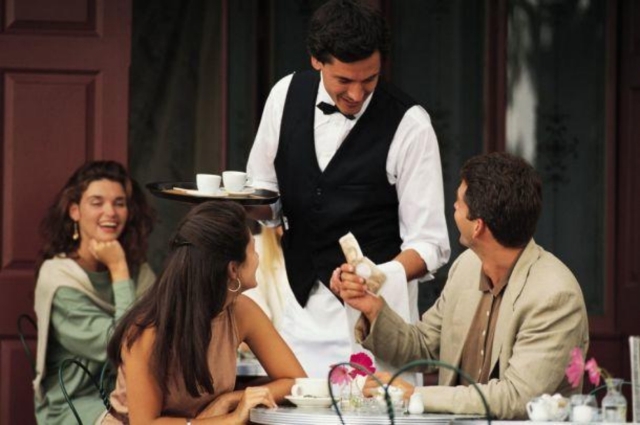
Everybody wins.
You collect the big tip for introducing him to guilt-free sausage. He goes home with his utterly infatuated date who has no idea what she’s in for, and you—with your obvious command of the data—attract the attention of the stunning brunette with the dangling earrings and those magnificent teeth.
For sticklers keeping score: Yes. You win twice. But it cost you a semester and he only had to pay the check. Fair’s fair.
Feedback, please
If this is exactly like the advice you’ve received in every other writing class you’ve taken, I’d love to hear about your earlier experiences.
If, on the other hand, it’s a fresh way to consider the task of crafting an academic essay, well, I’d love to hear that too.


 alwaystired247
 AnonymousStudent
 azntaco
 beforeverge
 BigBabyBaller
 bitagaming
 breakingbad1820
 Caravan
 cinderella1013
 davidbdale
 Yankeelover18
 fatboy489zt
 giantsfan224
 glacierfreeze21
 gobirds17
 green0728
 gymrat230
 Gir
Gir jerseymikes1106
 jesusisking1738
 jetsfan806
 Kenneth Alex Krug
 manipulator66
 mercythyhealer14
 McCormick Karner
 mochaatrain
 oni
oni powerranger
 peanut2348
 pinkcottoncandy4
 princess01430
 redbird1123
 rubes1256
 shxrkbait
 sillyinternetperson
 soulpond47240
 spatel8267
 stingingcrib5
 tacotyphoon
 thepersonindisguise
 usmnt23
 worldofjuice999
 xephos1
 Counterintuitive Fall 2022
I don’t really think I’ve ever been given advice on writing and how to deal with customers. I’ve never really taken a writing centered course before this one
This is a new perspective to look at on how to write an essay, like you are selling something to a customer that they were not particularly looking for. This is a great way to think of how to write an essay because it makes you work even harder to convince your reader of whatever you are arguing
This was an interesting way to look at advice on appealing your reader. There are a lot of good analogies that I would not have thought of but it makes sense that in a way you need to “flirt” with the reader and give them opinions that they can agree with and support so that you can get them to support your new ideas.
I have never heard this advice in any of my English classes before. This is a very interesting way to think about an argument and selling your claims. It helped me understand what I must do to sell my points.
I really love the metaphors used to connect the different parts of a restaurant to a writer, his/her material, and the reader. It really helped me understand what I need to do to steal that reader’s attention and it made me understand some of the pitfalls I should avoid. I’m already thinking of ways I can phrase bits and pieces of my argument to sound… good!
I have never heard this way of thinking/metaphor, so I thought it was very interesting. How you were able to compare writing, an author and readers to the way a restaurant runs. With the customers as the reader as well as the chef, the kitchen and the server to different aspects to an author. I have never head of this throughout my other writing classes, so I truly thought it was an interesting way to think about the topic. It really put it in a different perspective.
This was a very unique way of explaining how draw in a reader and convince them about the material you are presenting. My earlier years of writing, my teachers would just give straightforward instructions on how to construct an argument.
This was extremely helpful being that it is a common real-world scenario that many can relate to.
In my previous experiences in writing classes I’ve never really considered the idea of being the kitchen, chef, and server as deeply as it is explained here. Although I’ve probably heard the basic “you’re the chef and the reader is the customer,” I can’t say that it has ever made that much sense to me until now. With this specific analogy there is much more focus on preparation and working with what you have rather than just pure and simple execution.
I find that this is a new refreshing way of looking at writing argumentative papers. I think that being the guidance in your reader’s decision and doing everything in your power to convince them of your point can be explained perfectly by this server metaphor.
I think this advice was very useful and a good example of a real-world experience we have all gone through like going to a restaurant. I think it was interesting how everyone played a role just like the server convincing the customer what the better meal option was. The thing that really stood out was the idea that the server never force the customer to do anything but rather used the method of mentioning things to possibly start an appetite. This was an eye-opener to see what my writing needs to be like in my essay and helped me understand that convincing is not a war between two people but rather a conversation.
I’ve been told to find the balance between stupid and genius in my writing. Don’t talk to the reader like they are five years old but also don’t talk to them like they’re the smartest humans in the world. Both are very distasteful and won’t sell your work. Being that the type of writing we’re doing, I’m going to have to find the balance of the smart vs. dumb but also make my academic sources seem coherent enough.
In the writing class that I had taken last semester, we had not really addressed the fact that we should be very attentive based on what we are writing and look at the fact that our audience is important to think about when writing your essay.
When writing you have to be the kitchen and the chef. Being the kitchen means that you can only present so much information based on your research. Do not stretch yourselves thin when introducing your information because the information you do present can lose its meaning when it is surrounded by so much other information. Being the chef is you working hard on your assignments even without it being part of your major. This is important because while it may not seem important because it isn’t part of our major, this class can give us a lot of help in our professional writing in the future. We are also the server because we are presenting all the information ourselves, and we can plagiarize other sources. The customer is our reader who thinks they know everything, but we have to write in a way where no matter what they think, they are inclined to believe what we are saying or even considering it.
This was an interesting take. The examples with the drinks and appetizers were helpful for my understanding. I think I’ve heard some of this advice in the past. However, there were aspects that were newly introduced to me. The Do’s and Don’ts list was beneficial to sum up the lesson though. Overall, I think it truly is important to reel in the “customer”/reader.
This was definitely new for me. This like the Bobblehead strategy are both great examples of convincing your reader to look at things differently. Both strategies involve slowly coercing your audience into seeing things your way.
This is actually different advice from what I have heard in other writing classes that I have take. Even though it is different, I feel as if though it helps me with my writing more than those other classes.
I have never heard this take on an argument before. This is a very interesting way of selling claims and presenting an argument to the reader. I now have a different way I can help make my reader see my point and get them to agree with me on my stance.
This is the first time I’ve had writing described this way. It’s usually cut and dry; research and then spew your research in a nonsensical way to hopefully win over your reader. This way gives a more logical and straightforward approach to softly but confidently win over your reader.
I’ve never had writing compared to serving it is quite enlightening. I have always had examples of good rhetoric played out in places such as restaurants, grocery stores, etc but beyond that no talk of serving as an example of how to write. I do like this strategy but it is easier to see someone else do it than do it yourself, both serving and writing I mean.
This explanation and example were very different from what i’d seen before but I found it very helpful to my understanding. When I think about my writing like this, serving a customer, it helps me see how carefully constructing my writing will help portray what I am looking to explain to my reader.
I don’t think I’ve specifically heard this advice in other classes, but it makes sense. You want people to agree with you in your writing, and those tactics are the same as selling an item. They can’t be given a reason a doubt.
This definitely a new approach to the process of persuading the reader. At some point, English teachers always teach about being specific and trying to get the reader on your side without arguing with them, but not once did they spend time explaining it like serving food. The metaphor is actually helpful cause its easy to imagine and understand the correlation between our writing and wanting the customer to buy the most expensive item on the menu.
This was something new for me. I did find it very helpful though and I think it is something I can incorporate into my strategies when writing.
This was an interesting metaphor to explain the writing process. I think relating writing to a scenario we have all been apart of helps keep us engaged in the discussion. I have never thought of the waiter as selling us something when I sit down at the table. I have heard some of this advice in the past in a more cut and dry manner. I like that the discussion can be easily summed up to the do’s and dont’s list.
This was a interesting way to learn more about writing my essay or any others posts. It gave a lot of examples from the bar and connect it with how to writing a post. Being a chef is more challenging to cook, to know what we have and how to use it wisely.
None of my other writing classes compared writing to serving but it makes complete sense. In a way, we are serving our audience our point of view as if we are serving them a middle, introducing only our best points and addressing any doubts they may have.
This is a new strategy for me. I do not have a lot of experience writing papers because it was not something my high school had done frequently, so each of these tips have been extremely helpful for me.
I’ve never really had an analogy like this before when it comes to writing. I’ve never had it explained to me so clearly before. I was always told that I needed to make my writing clear to the audience, but I was never told to guide them into seeing what I wanted to say.
No other class has provided a lesson that used cooking as a metaphor. It was explained very well and all of the comparisons applied nicely to gain a good understanding of your role in your writing, from research to actually guiding the reader through your paper.
I like this analogy a lot since I work at a restaurant. I’ve never made the comparison before, but it actually makes a lot of sense and is very helpful. You are selling information like you sell food, and if you do it poorly the audience will not tip you. I will definitely use this idea in the future. This writing class is actually very different from all the ones i’ve had before. This class offers ways to look at writing very differently, and I feel i will be a much better writer by the end of this course.
This is one of the best analogies I have seen in a while. Not only does it give great detail on what your paper should entail, but it also reinforces that it is okay to change as you continue your report. Throughout my years of English, I have been told to make sure my audience is clear, and they are involved. However, this paper focus on showing your audience what you want. Not what someone wants to hear.
I’ve really learned the absolute perfect ideas on writing through this class. This was an interesting way to learn and implement on my writing essay and posts. I liked the way our writing is related to the kitchen. The chef and server are basically the writers whose job is typically the most difficult in order to make the readers ( customers ) satisfied.
I believe this advice will definitely be something I use in my work during this class. It lays out the information in a way that is understandable.
This is a very different way to introduce a new subject, it is definitely different than the structure I have gotten in my other writing classes.
I have not really got taught this way of putting a paper together it very help because if my essay is boarding that is just like given the wrong person the wrong and taking it back.Also I gained an understanding on it
I don’t think I’ve heard of lessons in writing like this one. It was very clear in what it was trying to explain and how each part of “serving the customer” is like accommodating to a reader.
I loved this metaphor, it’s one of the best we’ve gotten in class so far I think. I’ve had the importance of making definitive claims and persuasive rhetoric plenty in the past, but the emphasis on guiding was a little newer to me, and it’s already gotten me thinking about how to improve my writing moving forward.
*heard the importance, not had
I think this advice was a lot of the same information I’ve heard before but presented in a way that makes more sense and is more useful to me now. Before I think I just got the instructions without any explanation and now I know exactly what I need to do with the information I’ve been given all along.
I have never thought of forming an argument this way. I think the explanation and metaphor of the server and the customer help me understand what direction to go in to create my argument.
This is probably one of the coolest metaphors I’ve heard of in a while, and this is a really great way to think of writing and trying to relate and accommodate to the reader, which I never really thought of before. I’ll definitely remember this for a while.
I love the metaphors you used here, I think what you’ve explained through the metaphors is something I’ve heard before but definitely explained more in-depth and more of an understanding with your explanation. I think the biggest difference is the thought of having to guide my reader instead of just giving them the information so clear, cut, and dry.
I have never been given this kind of advice before about writing. This is the first time I was told to compare myself to a server/chef/kitchen and have the readers be the costumers. Hearing this new perspective on writing gave me a better idea on how I should present my topics to the readers in a timely and interesting manner. I really did enjoy the comparison of the two and how it all connected to pleasing the reader/costumer.
I think this metaphor is really great and helpful in describing how to communicate your topic to youre readers. It is true that when the server gives you more specific options rather than leaving it open-ended, you’re more persuaded to want to buy things. Similarly, we should give our readers only 2 options of agreeing or disagreeing, so that either way, you still got their attention and they were invested.
In essentially every other writing class I’ve had there has been no focus on the reader or about delivering the ideas in a clear and quick manner. Most classes I’ve had in the past have just been about meeting a word count or regurgitating information or both. This idea that we need to focus on who is reading in order to compel them is something that I think will help me become a better writer as well as a better waiter if I ever choose to enter that line of work.
I see you’ve responded more than once, RS. That’s my fault for linking you to a page from an earlier semester (with the same lecture material). Because you had never posted a Reply to THIS blog, your first one needed to be moderated before it would appear. It’s a strong Reply, which I appreciate. Thanks (several times). 🙂
I haven’t heard anything like this metaphor but I think it is very unique. Putting us into the perspective of acting like an essay is a bar will definitely help avoid us being too vague with our writing. Not only this it helps us get straight to the point instead of beating around the bush by hinting at what’s to come. This way of technique for our essays will definitely be beneficial to my writing and I will make sure to not confuse readers and try to manipulate them into seeing my perspective whatever that may be.
This is most definitely the most unique approach I have seen taken on the stance of crafting a piece of writing to not only entice the reader but to adequately change their opinions.
I have never thought of this metaphor before and was never taught. Although I’m not fully familiar with it, I understand the basis and it helped me understand how to properly present my argument. When I am constructing my argument, I will definitely consider this metaphor and everything that relates to it.
No, I haven’t thought about writing in this way before. Nor have I been taught in this way before. I think the metaphors are beneficial but too much time gets lost and spent on building the metaphor and not enough examples of what the mistakes would translate to within our own essays.
Thank you SOOO much, QueenRandom. I needed the feedback about swapping out the concept oversell for examples of good and bad “serving.” Much appreciated!
This technique is vastly different from most classes that I have had in the past. Most classes have focused on word count and regurgitation of information rather than focusing on how to engage the reader. I believe that this new information will allow me to become a better writer and a better waiter should I ever enter that line of work.
I see you’ve responded more than once, RS. That’s my fault for linking you to a page from an earlier semester (with the same lecture material). Because you had never posted a Reply to THIS blog, your first one needed to be moderated before it would appear. It’s a strong Reply, which I appreciate. Thanks (several times). 🙂