
12 Class THU OCT 13
Life Choices

Mandatory Conference 2
A reminder. Your 2nd Mandatory Professor Conference, “Evaluate Your Thesis Progress” was to have been completed by today, THU OCT 13.” If you haven’t had a conference, follow the link to the Conference Chart and set one up. Make a note of this in your Agenda Notes for today so I know you’ve seen it.
Writing Mechanics
DUE TODAY IN CLASS or by 11:59 pm today
Lecture
The Bobblehead Strategy
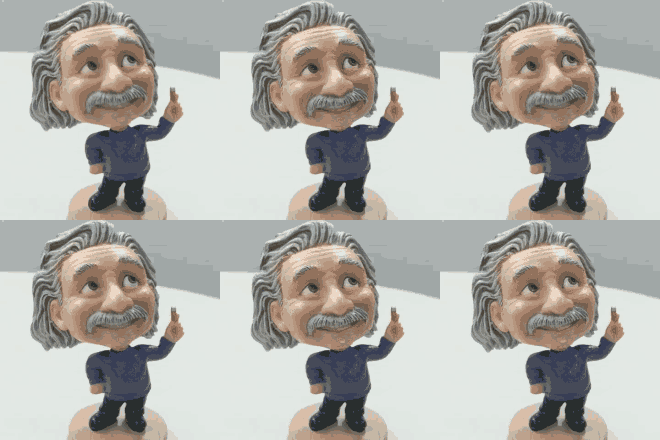
Claims Work
The sales pitch version of the LASIK story designed to be soothing while acknowledging the slightly barbaric-looking process of carving a flap into a patient’s cornea.

The hilarious result of grabbing whatever graphic is available for inclusion in your sales material:

Our actual class work

- Link to the Lasik Surgery Claims Demonstration
- A lecture on claims that includes a chart for applying several claims types to your own hypothesis.
Aristotle: Logos Ethos Pathos


 alwaystired247
 AnonymousStudent
 azntaco
 beforeverge
 BigBabyBaller
 bitagaming
 breakingbad1820
 Caravan
 cinderella1013
 davidbdale
 Yankeelover18
 fatboy489zt
 giantsfan224
 glacierfreeze21
 gobirds17
 green0728
 gymrat230
 Gir
Gir jerseymikes1106
 jesusisking1738
 jetsfan806
 Kenneth Alex Krug
 manipulator66
 mercythyhealer14
 McCormick Karner
 mochaatrain
 oni
oni powerranger
 peanut2348
 pinkcottoncandy4
 princess01430
 redbird1123
 rubes1256
 shxrkbait
 sillyinternetperson
 soulpond47240
 spatel8267
 stingingcrib5
 tacotyphoon
 thepersonindisguise
 usmnt23
 worldofjuice999
 xephos1
 Counterintuitive Fall 2022
My Notes –
Claims: With two different audiences, the author can adjust claims to both arguments. Ethos, Logos, Pathos evaluations.
Definition Argument: Purpose of a definition categorical argument is to stick to your own claim or concept. “Political Paralysis.”
Class included a lot of examples. Also apologize for very very short notes.
– Ava’s Lasik surgery – logos, ethos, pathos. Appealing to parents and insurance.
– Political Paralysis – Continuation on model polio essay.
– Presence in class required – Another model definition/categorical essay containing students’ participation and presence in class.
Short Notes is OK if you’re thorough.
3/3
2/28/22
-putting a price on something like time allows people to take advantage and know what the price to pay is for their actions
-aristotle’s method of ethos, logos, and pathos allows him to never call anything a claim, only a way of appealing to the audience.
-finding common ground for such controversial topics like abortion is very difficult because it is a lose lose situation. Nobody wants to have an abortion, however they do not want an unwanted pregnancy.
-not all claims need to be proved.
-ava needs to use different strategies of ethos, logos, and pathos to convince her audience to cover 100% of the cost.
-she needs to address her mom and dad in one way, and her insurance company in another
-making categorical claims and causal claims to her parents
-stake your territory in your argument for the essay
-in order to eradicate smallpox, it had to be eradicable
-the purpose of the essay is to decide what category you are going to fight for your topic to be in.
-the political paralysis claim did help because it showed ways to go into specifics and using many different claims that show one side of an argument, knowing that there is a whole other side that can be shown with evidence and proof.
This very simple statement is the essence of a good Definition/Categorical argument:
3/3
-with control groups you can view how people behave
-professor hodges expressed how his earlier classes always do better , and he believes this is because after 9:15 when he starts to repeat himself it is not as good as the first time.
-I agree with kids getting nervous when their parents do not show up on time to pick them up because I used to be in an afterschool program and would get worried when it was getting close to closing time and I was still there.
-if you are writing about dangerous drugs , don’t let the pharmacy think they’re off the hook. This is an ethical argument as well as an emotional one.
-not every step of the way needs to be proved when writing
– With Ava she has to make 3 categorical claims to get her mom on board about her getting lasik surgery.
-With lasik , you save money from buying new glasses every few years with just getting one procedure that sets you for life.
– An example of “ Is X a Y?” would be , Is Ava a good candidate for lasik surgery? Is lasik a safe procedure? Is lasik an effective procedure?
-The Nike Ad with Colin Kapernick was a good one because it talks about following your dreams even if they don’t seem achievable. This is important because people will often try to downplay what you wanna do because it seems impossible but you can do whatever you put your mind to.
– I like Colin Kapernick alot because I watched his story on Netflix and he is very inspiring. His journey was not easy at all and there were times where he wanted to give up but he did not. He did what was necessary and his dreams came true and he was very successful and still is.
– ”Is sugar a drug?” was a question asked in class as well as “ What is a drug”. There are good drugs and bad drugs. The good drugs are the ones sold over the counter in the pharmacy and the ones that are prescribed by doctors where on the other hand the bad drugs would be the ones on the street like cocaine , meth , etc.
– “Is polio an eradicable disease?” – I talked more about this under the political paralysis post
-I believe that getting rid of polio will be harder because in other countries that have not as good health care systems. It was stated that the disease was sneakier so its harder to detect when it would be coming. The USA has been polio free for a while because they came up with a vaccination for it.
– the political paralysis requires a lot of evidence
This is also a good categorical question. What if what everybody calls “impossible” turns out to be “achievable”?
Good Notes, Chance. Thoughtful and thorough.
3/3
An example of definition claim: Radial keratotomy is a discredited experimental procedure using scalpels. An example of resemblance claims would be: Ava’s situation resembles her parents’ situation in their youth.
If you put the claims in a chart it would look like, is X a Y, What is a Y, Does X Cause Y, Is X like Y. Nike made a commercial for Collin Kaepernick, it was actually pretty good in my opinion.
The attempts to answer this question, “Does polio belong to the category of eradicable diseases?”. If you haven’t left a comment on the “Political Paralysis” post, do so before class is over. The class is “Presence Required,” but some students will be excused from having to attend in person.
A Protected Class that Deserves Heightened Scrutiny. They want us to list some types of students who will be automatically excused. Moving from the specific to the general, we find ourselves making moral or ethical claims about fairness that expose our basic social beliefs.
Notice that we have considered very specific cases and evaluated them to find underlying similarities or categories. What characteristics do those students share in the picture that we all just saw. I believe that if you try to get rid of polio it would be harder to get rid of, but they made a vaccine for it, they also should be added to a category because it is very difficult to get rid of it
Very thorough, Bubba.
3/3
In one sentence that you may look at in a form of text, you may see more than one claim. Although you may only see one meaning of the article there is always a smaller meaning which is different types of claims.
Ethos, Logos, and Pathos are important to use one of these in your writing to show reasoning, emotion, and character. These all work well together to make your r writing pieces a lot stronger and more qualitative.
When writing your argument you have to be aware of your audience so that you know the type of claims that you may need to make a good argument about a topic. This is what we have to be aware of when writing our small papers because we don’t want our audience to not want to read our papers we want to inform them with an effective claim.
The definitional claim essay is coming around the corner which in my opinion is making me a little nervous as we know that this task is not easy. There may be some barriers that may be in the way which may cause me to get stressed but in the end, it will turn out good. The best way to look at the definition argument is to think about the definition that you are trying to stick with for 3000 words. The dictionary is not going to be our best friend in this situation which makes it more creative.
How are you feeling now about the progress you’ve made on your Definition argument, Devils?
3/3
Aristotle made appeals to his audience’s reason, to their emotions, and to their sense of ethics, character and authority, without ever calling anything a claim.
Toulmin made claims and supported them “with grounds.” Based his arguments on warrants (the value which argument rests on.)
Rodgers concentrated on finding areas of common ground and solving shared problems.
Unstated claims often go by unnoticed and require no proof.
Not all claims need to be proved.
Claims that would readily be accepted by your intended audience need no proof.
First 1,000 word essay deadline coming up next week.
Takes home task due before next class.
That’s not much of a summary of the Claims Unit, but the points you make are valid and important.
3/3
Day care centers in israel relied on parents to drop off and pick up children everyday, they decided to imply a small fine for parents who picked up their children late
They decided to turn it into an experiment splitting it half and half
The group that was going to be fined had doubled lateness
The morales had gone out the window and they used the fine as a commodity
Then removed the fine and it stayed the same way with double the lateness
Very counterintuitive
Aristotle introduced pathos logos and ethos
Common ground in every argument
Solving shared problems
Need to structure argument/claims like the exercise sheet with all the different categories ending
with proposal
Have to find what category your item fits into and which ones are close to it
Very helpful understanding the importance of an argument and how to express one in a very educated and efficient way that takes facts from both sides and transforms it into a persausive essay
Good to hear you found the lesson instructive, GB. I’ll be REALLY impressed if you actually use the chart to track your claims. That, I’d like to see!
3/3
– Ava presents very strong claims when she is convincing her parents that she needs to get lasik eye surgery. Ava comes up with effective counter arguments with very effective claims about potential problems with her career, comparisons to solutions in the past, and it isn’t that risky. When looking at the chart that was completed for Ava, it was really easy to understand her claims.
– The commercial shown in class was very interesting use of the three types of appeals. The most obvious of the three was pathos which was shown throughout the entire ad through seeing all these great athletes achieve unbelievable accomplishments and heights. The other two were less obvious and I’m not fully sure where they were. Ethos is maybe shown by showing professional athletes who actually completed these crazy dreams. I don’t know about logos however.
– Sugar and soda can be considered drugs depending on what your definition of what a drug is. The technical, google definition is a chemical substance that causes a change in an organism’s physiology or psychology. While it seems that soda/sugar fits this definition, drugs are often differed from any food because food provides additional nutritional support.
Either way, it’s good to remind yourself how flexible definitions can be, NF. That’s the basis for your own 1000-word argument. You define your important terms as YOU want them understood.
3/3
Claims
Claims are assertions that are open to challenge.
Claims do not always need to be proved. The claims that are unstated do not need to be explained. The claims that readers would not object do not need to be supported. Claims that would be easily accepted by the intended audience do not need an explanation.
Aristotle
The use of logos, ethos, and pathos are crucial to use with the white paper. The implementation of these rhetorical devices allows for a more persuasive, thought-provoking, and clear essay.
Knowing your audience is important when trying to appeal to these devices through different claim types.
Definition/Categorical Unit
Do not use dictionary definitions to complete definition/categorical essay.
The purpose of a categorical argument is to make a claim that should explain the main premise of your essay. Furthermore, state your territory.
The sample essay for this clearly demonstrates the purpose of this portion of this paper. Moreover, it provides an argument that is easy to understand, due to supporting information like comparing it to smallpox.
I particularly like your section on D/C, Spy.
3/3
– ethos, logos, and pathos can work together
– hypothesis is a claim in and of itself
– get them on board with the basic premise of your argument
– claims are extensions of the three
– recognize the counter claims
– categorical/definitional can be used to show that two or more things aren’t alike
Recognize the counter claims?
2/3
Lateness doubled in Haifa, Israel when a fine was imposed for picking children up late from school. Lateness turned into a commodity.
“10 mins is only 3 bucks?! I thought I was holding up the entire system!” -a parent in Haifa (probably)
Claims
When writing sentences with numerous claims it is evident that a hundred words of meaning can be packed into just twenty words.
Aristotle: Pathos, Logos, Ethos
Toulmin: Grounds, Warrants (Values), Backing?
Rogers: Common Ground and Shared Problems, Identify Differences in Opinion.
Claims are an assertion that are open to be challenged. Although, not all claims need to be proven.
If you can agree on the basic premise of your argument you can get right down to the shared values (warrants) within your argument.
Resemblance Claim: How someone may have made a similar argument in a similar situation in the past.
Arguments usually follow a problem, solution, justification structure.
*Claims Chart*
Definition
What is a drug?
How do we define it so food isn’t a drug… so oxygen isn’t a drug
The dictionary can’t help!
Categorical
Does Polio belong to the category of eradicable disease?
What made smallpox eradicable was that it could not develop from nothing. Zero cases means no cases ever again.
Has to have vulnerabilities. If it doesn’t kill its host every time it will not spread effectively.
If it meets the criteria it should be eradicable
Political Paralysis
This model definition/categorical essay definitely gave me a much better idea of how to go about constructing evidence for my own arguments. Making comparative claims to support a categorical claim seems to be very effective and I am going to try to incorporate this technique in my own paper (if strong enough comparisons can be made).
I love to see evidence of direct application of classroom lessons to the “work” of the course, SillyBones. Thanks for talking yourself through the process.
4/3
*When a daycare kept having late parents at the end of the day, the daycare put in a 3 dollar fine in place so that the parents would not show up late. But the parents ended up showing even later. And that was because the daycare put 3 dollars on lateness, so the parents did not care.
*Claims are based on grounds are based are warrants
Your challenge is to prove something that not everyone agrees yet
If you can get everyone to agree on a common ground then you can get to the point \
*The purpose of a definition categorical argument is to stake your claim
It is a distinction that creates a difference
*The purpose of a 1000 word argument is to decide polio belongs to the category eradicable disease
*You could write a negative or positive paper on polio
*In a class where presence is required a group of people would be excused, which types of students would be excused? Would they belong to any particular category?
What sorts of students deserve would change the argument to a moral question
*Does the constitution give them the right to get married to the same gender
Best Line: Your challenge is to prove something that not everyone agrees yet.
3/3
Our class began with our discussion about claims. By using an example from our PTSD claims assignment. Using one singular sentence contained six different types of claims. Which was fascinating to me because when I read the sentence I initially only saw one claim, until the sentence was broken down further. Aristotle was brought up, I have previously talked about logos, ethos, and pathos in many english classes. Logos means to use facts and reason to propose a claim. Pathos means to use emotion to persuade your argument. Lastly, ethos is using authority to persuade. Having an intended audience is very important in making claims and persuading them. Then you must figure out what path you want to take in making that argument, if you want to use logos, ethos, or pathos. We discussed an example of getting lasik eye surgery, and persuading parents to pay for the surgery versus making a claim to the insurance company to pay for the surgery. You have to make different claims based on who you are trying to persuade. When persuading your parents you may use ethos and pathos, while making a claim to the insurance company you would be using logos. We watched a short Nike ad featuring Colin Kapernick, who as we all know in the past has been very controversial. He talked about dreams, and questioned if our dreams are wild enough. We began talking about definitional and categorical units. The purpose of a definitional argument is to state your own claim of the meaning of the term and having the concept understood. It is not using a dictionary, it is making your own definition and claim. A categorical claim is if a topic fits into a certain category.
This is just full of important lessons.
4/3
COMP II Notes – 2.28.22
Control group
Lateness doubled + persisted
Commodities
Went over claims
Categorical, Definitional, Casual, Resemblance, Evaluation, and Proposal claims
Example: Ava’s argument to get Lasik and have her parents pay for it
Lasik Eye Surgery
Worth it?
Narrow down on categories
No benefits in dictionary definition
Ex) how to define a drug; can be taken through the mouth or skin…
Model Essay somewhat helped better my understanding of categorical and definition claims
Interesting comparison to support claim/argument
Small pox & Polio
If we can eradicate one we can eradicate another…
Note to self – 1000 word essay due soon
Do you actually remember what this means? 🙂
3/3
2/28/2022
A daycare realized that parents were showing up late for their children so they decided to fine parents every time they were late and the lateness doubled. This is a constrictive story that was supposed to end with a solution that ended up staying the same after the fine was taken out.
The parents did not feel morally wrong or obligated to get their children while the fine was put into place meaning after it was taken away the parents still kept the same mindset they had before.
There can be so much meaning packed into a sentence by using different claims as we were shown by one of the students work on the PTSD assignment.
Toulmin has the concept of starting off with claims, grounds, warrants, and backing
Rogers wants to figure out how everyone can agree with one another on different topics. Finding the common ground to help accomplish something that everyone can agree with.
The hypothesis is a claim that has to be proven by using prof. We need to find our intended audience to possibly avoid the background aspect in the essay.
Ava wanted to get Lasik surgery and get her parents to agree and for the insurance to pay the full price. She came up with different claims to support her position. For example, she came up with a categorical claim like this surgery is good for people who are twenty years old and a
a causal claim which is what motivates her such as possibly becoming a scuba fiver in the future.
Problem (pathos) – Hard time seeing overall and glasses can be uncomfortable
Solution (logos) – Lasik surgery
Justify (Logos) – This investment will decrease the amount of money spent on glasses, eye appointments, or even contacts.
A definitional and categorical essay is due on Wednesday and has to be 1,000 words not including any dictionary definition in it. For example, we talked about how a drug has to be processed and has effects on people’s behavior, metabolism. A drug can be given by the mouth as well as absorbed by the skin itself. How do we define a drug to be helpful to identify that food is not a drug but sugar is one? A categorical argument is Smallpox to Polo and how a disease has to be eradicable so it hits the 0 mark. Questions on how it can be treated by a vaccine for example. We can make smallpox categorical and then we can change our perspective and make it seem every differently such as saying First how effects are shown on the body, Second how polo needs 7 vaccines and Smallpox only needs one vaccine, Finally how the vaccines themselves can affect people. Make sure to include references
I do think the example of the essay was very useful and gave a good overview of what the expectations for the essay look like. It also looks like the essay is not so much formally formatted but separated into different arguments some smaller and others bigger as well as opposing statements that can be argued with the audience.
Super-thorough Notes, Cookie!
4/3
Class Notes:
These are the ways to write a citation:
Author, in “Title,” said that “quote.”
Author claims, in “Title,” that “quote.”
In Author’s essay, “Title,” Author claims, “Quote.”
In his essay, “Title,” Author claims, “Quote.”
In “Title,” Author claims: “Quote.”
Author says “quote.” He makes this claim in essay, “Title.”
That “subject verbs” is a claim Author makes in “Title.”
“Quote,” according to Author in “Title.”
Professor Hodges explained these citation methods in class and it is a great example, being the fact that writing citations are very important in a person’s writings.
-The bobblehead strategy is getting the audience to quickly start nodding to an agreement of small proposal claims. And you keep giving those proposal claims until it leads to them nodding yes.
-Even though being persuaded over and over and over makes a person feel trapped in the moment, that person will find it hard to throw away all of those good points so it leads to an agreement.
-To avoid a mob mentality when trying to prove something, one strategy is to make everyone agree to smaller propositions that everyone you know would say yes to.
The same word being put in different places of a sentence can change the entire claim of what the sentence is set out to mean
When using the word “only”, it is always referring to the word in front of it unless there is no word in front of it. It is then referencing the word behind it.
Identifying the author, title, quotation, and using said language is a good use of citation
Incorporating the quote into the language of your own sentence, you don’t capitalize the first letter of the quotation
When citing, make sure to use the entire name of the author when first introducing them, then you could use their last name.
Your job as a writer to persuade the reader is to ease them into your argument and not just blurt out what you want them to believe
Make them agree to the conclusion if the conditions are met and then make your own conditions.
* ’ve set an appointment for the mandatory thesis conference
* Only is a very important. Where you place that word can change the meaning of the whole sentence. Only refers to the word after.
* When you misplace only, it will be known. It’s an easy fix, and eventually it will become a second nature
* Good citations can be done in a specific way, they identify the author, they have a quotation of some sort, and they have to say language.
* The quote that you use doesn’t have to be capitalized. If it doesn’t work out with the grammar in the sentence you are writing then don’t. If it doesn’t follow a comma, you can capitalize it
* Example: author claims, in “Title” that “quote.”
* The trick of the bobblehead strategy is to get the audience to agree with what you’re saying and give you some small yesses
* You’re audience may not agree with being persuaded or trapped into agreeing with you, but they may find it difficult to go back on their small yesses
* Make some suggestions that the audience will have to agree with.
– Be careful with the word “only” as it can be misunderstood easily in writing when placed in the wrong place.
– “Only” refers to the word that always comes after it. If there are no words after it, it refers to the word before.
– Quotations have a lot of specific rules, be careful with grammatical errors.
– If a quote is being used and it comes after the word “claims,” the first word is capitalized no matter what.
– Assume that the readers are reluctant to change their minds, meaning our job is to ease them into our viewpoint, and not forcing them into a defensive position too early on.
– Getting an affirmative “yes” or “nod” is important early on to ensure you can get them to agree with you later on.
– When the burden shifts from you having to persuade the reader to them having to refute you leads to you basically winning the argument since they have almost nothing else to say.
– Framing arguments in advance and getting them to agree to a conclusion makes convincing them easier.
– Prep the audience for bigger propositions by leading with smaller arguments.
– Logical analogies can nail down a strong Conclusion.
10/13 Class Notes
I have completed my 2nd mandatory conference with Professor Hodges. I found it very helpful to discuss the type of sources I should be searching for. He also helped explain and brainstorm ideas for my definition argument.
The placement of words is essential in distinguishing how a sentence will be perceived.
The word “only” refers to the word that comes after it in the sentence “she told him that she loved him” when the word only is added into the sentence in various locations.
Good citation language should include the author, title of the article, a quotation or paraphrase, and uses said language.
A comma should always be included inside the quotations when needed.
When we use the phrase, “claims that” in our writing, the quote that follows is not capitalized. If the word “that” is not included in the sentence then you would capitalize the beginning of the quote This is because you are incorporating the language into your text therefore it does not need to be capitalized. Essentially if you state the Authors claim then the quote following is capitalized. If “said” language is used then the quote following is not capitalized.
When making an argument we don’t want to make a claim that will automatically make readers reject the idea. Upfront and unexpected claims often lead to an immediate rejection of the question. If you insinuate yourself into the point of view of the person you are asking it is more effective in getting others to agree. The bobblehead strategy is used to get your audience nodding their head in agreement to multiple small questions that will lead up to the big claim you are trying to make as an attempt to get others to agree.
The goal is to get readers’ burden of proof to switch. This will make it hard for others to be able to disprove your claim and refute it with the opposing one.
I scheduled my conference for 11:30 AM next Wednesday and I have no idea how I missed the deadline but I’m really glad we were reminded.
In the sentence “She told him that she loved him,” there are nine places “only” can be placed and it changes the meaning of the sentence accordingly. The scenarios of the situation described change drastically based on where you put the “only.”
Good citations identify the author, title, and could contain the name of the publication. They may also contain a quotation, paraphrase, and usually have “said” language. If quotes are incorporated into the sentence, they are usually not capitalized. Though, if there is a pause and comma before them, it is not.
Our readers will read what they want to read and be reluctant to change their minds. This is why you have to ease them into agreeing with you and not just flat-out demand they do. For example, if we were to try to convince people that therapy should be enforced on everyone whose mental health is a harm to themselves and others, we would have to make small claims first to support our points. If we flat out said something like “youth who are in need of therapy should be required to receive it,” the majority of people would get angry. They would ask questions like “Who are you to deem who needs therapy?” or “How do you know therapy works?” You can fix this by saying something like, “Society functions best when everybody is healthy enough to contribute,” or “Depressed youth are statistically more prone to substance abuse, violence, and self-harm, even suicide,” before you flat-out state your argument. We could go on to make a proposal such as “Therapy should be available for every youth who desires it,” which will give us a much better chance of being approved. Then, we can specify who it is we are referring to. This can be done in a sentence such as, “Many depressed youth already receive and benefit from the therapy they know they need and desire.” Finally, our final product should look something like “As a benefit to the patient and his/her community, an exploratory course of therapy, at no cost to the patient, should be mandated for every youth who is diagnosed to require it.” Once our audience agrees with this, we can address rebuttals. This will assure a strong conclusion, getting rid of any doubts our audience may have.
Life Choices
Cream and sugar are not lifetime choices
You can’t use one option in order to get another
Mandatory Conference 2
Make sure to schedule a conference with Professor Hodges
Writing Mechanics
There are 9 places that you could place the word “only” in the sentence
In conversation we say “only” …
“Only” modifies the word that follows it
“Only” in front of she means her and her alone
“Only” in front of told means that she doesn’t love him
“Only” in front of him means she told him and him alone
“Only” in front of that means that she told him one thing
“Only” in front of she means that no one but her loves him
“Only” in front of loved means that she doesn’t like him
When “only” is at the end of a sentence it modifies what came before it
Good Citation Mechanics
A good citation identifies the author
A good citation identifies the title of your source
A good citation contains a quotation
A good citation uses SAID language
The first letter in a quote should be capitalized if you use SAID language
The only time you don’t use just an author’s last name is if you have two authors with the same last name
The Bobblehead Strategy
Nodding your head means yes and shaking means no
You want people to say “yes that’s reasonable”
Get whoever you are convincing to unwittingly start nodding their head in agreement to a series of small and innocuous-sounding premises
Your audience may not appreciate being persuaded
If you were to suggest that therapy should be mandatory to those with mental illness there would be a negative reaction
In order to avoid the “mob mentality” from your audience, start with simple points that you can get your audience to agree to
We don’t want to come right out with a controversial point because that’s what warrants an objection from your audience
Claims Work
The sales pitch for LASIK eye surgery was designed to be soothing but it also brought up the crazy procedure needed to complete the operation
10/13
-Professor went over a statement “She told him that she loved him”
-The statement is in the past tense since “told” was used
-This showed that he does not love him
-We went over good citation mechanics
Examples of good citation mechanisms:
-They have identified the author
-They have identified the title of the article, essay, or story
-They have a quotation
-They also have said language
– We made our own claim and fixed errors in the citation stated
– Bobble Head strategy is to get your audience to unwittingly start nodding in agreement
– getting them to agree on a conclusion if conditions are met
– We talked about situations that could fall into this category
Notes:
– I already did my second conference.
– Placement of words in a sentence can change the entire meaning. The word placed in a sentence applies to the word after it.
– There are multiple ways to cite information from a source, listed in Good Mechanics on WordPress.
– The first word of a quote can be capitalized or not to fit the grammar of your sentence.
– Try to get readers to agree with smaller, simpler claims to be more inclined to agree to your overall claim.
– Move the burden of proof from yourself to your reader.
– Get readers to agree with a conclusion, as long as the conditions are met. Then your can explain the conditions.
-Only modifies the word it follows, so you gotta be careful in where you place and use it. When only is placed at the end of a sentence it comes back to the word behind it. Using “only” is implying that the following word is the only of its kind. If “only” is before “love” then that means the love is of one kind. It doesn’t account for two things. Just the one love.
-We can use a quotation as a good citation if it perfectly states what you need. Or you can paraphrase it if the wording doesn’t work with the point you are trying to make.
-If you incorporate a quotation into the grammar of your own sentence, then you don’t have to capitalize the first word or put a comma before the quote. Ex: Author claims, in “Title,” that “quote.”
-We want people to nod in the affirmative. You want little yesses from the reader. Use little statements that almost make the reader agree and be like “yeah that’s reasonable.” (Bobblehead technique)
-If the conditions are met then it’s hard to deny.
-Try and get the reader to the conclusion first. That should be the goal.
-Try to have a narrow proposal that can be agreed upon. From there you can get less narrow and start laying out some categories that slowly get less acceptable. Do not throw in an absurd claim that will make the reader disagree right away.
-Guide the reader slowly to the finishing statements that are closest to your argument.
-A good way to start an argument is with a radical claim, and then get slightly less radical as you try and persuade the reader.
-Seems LASIK eye surgery isn’t very fun.
She told him that she loved him.
Word placement can make or break the meaning of your sentence.
Good Citation Mechanics
There are numerous ways to cite others’ works in your paper, use what works best for you as long as it’s structured correctly.
Bobblehead Strategy
Ease into your argument. People have preconceived ideas and will be quick to argue for those beliefs. Get your audience to unknowingly start to agree with your argument. This is done with small innocuous-sounding proposal claims. You can make the same argument a lot simpler with smaller claims throughout.
WIll follow with more notes after reading claims types.
Class Notes-
The use of the word only.
Only modifies the word, or phrase that follows it
Example” She told him that she loved him”
Each place you put only in the sentence modifies the sentence
“She told him that she only loved him “- She only loves not anything else
“She told only him that she loved him”- she only told him no one else
Good Citation Mechanics-
List of good citation techniques to refer back to when writing. Use words other than said
There are many variations to how we can introduce a quote into our writing but we need to be sure we use the proper grammar for each method. (review link for this as well)
Bobble head strategy (A way to approach a reluctant audience)-
You want to get your audience to agree with a bunch of small claims before you drop your new idea on them. Its essentially a sales pitch.
We want our audience to be on our side from the start. When we start with a bold claim you will lose some readers and they can form a mob mentality.
We can use the method of stating small general claims that everyone will agree to lead to our bold claim. They have to follow a logical path to get there though.
Notes – October 12th 2022
I just scheduled my second conference for Oct 17th so I did see the post and appreciated the reminder.
“ She Told him that she loved his lesson”, casual conversation most often leads us to emphasize certain words without a purpose or subconsciously, however once you break down the sentence you can see that emphasizing a different word would change the meaning of the sentence completely.
For example, Emphasizing she means she’s the only one that told him that she loved him but if you emphasize told this means that she only told him, she doesn’t have to mean it and she didn’t imply it she told him that’s it.
Therefore the same concept applies to where to place the word only. This only in our sentences puts emphasis on different words and we want to make sure we are emphasizing the right word for our purpose.
Good in text citations identify the following items: Author, title, quotation, said equivalent. It can also include the name of the publication but that is up to your discretion. Said language examples are She said, she believes, she implied, she emphasized etc.
If you want to add a quote to the grammar of the sentence that uses “ that ” don’t capitalize the first letter of the quote but if you don’t if you just end off with claims or something similar then put a common and capitalize. Overall if it seems that you are incorporating quotes into the sentence grammar and it’s a nice cohesion don’t capitalize but if you are separating it in a little way capitalize it. ( This was a nice tip I never even realized the difference thanks)
Approaching a seemingly convinced audience might seem impossible but the way to do it is slowly but surely. Don’t completely bash an individual for their standing because without their standing there would be nothing to debate, so although it might not always feel like you have to appreciate them having a different opinion. Therefore ask first questions that you think or know that they will say yes to something that most normal people would say yes to. Example: “ do you want the best for humanity”. Most people would be like “of course” than lead to how your opinion will achieve this. Don’t literally ask in the paper because that’s too many theoretical questions but imply that if they don’t go along with your point then they risk being seen as the person who doesn’t care about what’s best for humanity. The only weakness is that if you are not convincing enough that your idea has nothing to do with what’s best for humanity. Therefore start with an undebatable, central point. Although this might seem like a trick, it’s simply technique. That’s business. The bobble head strategy.
Bold claims are good but not at the beginning of the essay. Don’t come in storms ablazing more accurately come in like a timid child in a candy store that knows that they will get candy if they don’t start asking for things right away but rather finds one thing in the store he admires and quietly to himself picks it up, puts it down, stares at it again, and picks it back up again. Eventually mentioning to the parent that the candy is “cool” and then the parent looks at them and says fine go and get it. Much more effective than crying or screaming as soon as you get in the store for the first thing that catches your eye. Letting someone come to the conclusion themselves of what you want is a technique that lets the audience think that it was partially their idea therefore it is more “okay” to conform to the idea themselves because they came up with it from what I said ( but really that’s what I meant to do).
Again make sure that when you make a bold claim anywhere in the essay define your terms so that the claim is more understandable and in some cases less absurd to conform to. Make sure when doing this to try to shut out any limitations to the argument that might exist that would make someone completely not conform with the argument all together because of the exceptions. Be clear, very clear. If we’re talking about mentall ill children. Make sure we refine it to what illnesses, age, level of treatment, danger to themselves, etc that you mean for mentally ill children.
No need to spend more time on ethos, pathos, logos. I don’t know about anyone else but those terms and their applications have been drilled in my brain since grade school and it might do me some good to have a semester without them.
Mandatory second conference to “Evaluate Your Thesis Progress” should be completed if you haven’t done so. I still need to make an appointment with the professor so I’ll do that as soon as possible.
Be careful with the term “Only,” as it is readily misconstrued in writing if it is used incorrectly. “Only” refers to the word that comes after it.
Good citations should include the author, title of the article, a quotation or paraphrase, publication, and said language. Some examples being: said, believes, claims, asserts, insists, etc.
The bobble head strategy is the idea of getting the reader to start unintentionally nodding their head to a series of small assertions that forces the reader to agreement. This is accomplished through the use of innocuous-sounding premises until the habit of agreeing to every premise leads to a big “Yes.” They will find it difficult to reverse all of the minor consensus points you acquired on the route to final approval of your idea.
-to start class we choose between what we value more (money, fame, service, and love) —mandatory meeting for thesis statements on 1000 word essay (Monday 9:30 is my spot)
-be a careful righter, make sure what you mean to say is the right thing your actually saying
-one word and where it is placed can effect the whole meaning of a sentence for example, the “only sentence”
-today we did a lot of work on claims and how we should be using them in our essay
-authors full name is used only once before the first quote, after that we should refer to him/her by last name
-the bobble head strategy refers to playing with your reader a little bit, instead of coming out and staying a claim your kind of season the reader up with information until they are ready to hear your argument.
-claim types can change how you approve your claim/argument through your essay
10/13
– 2nd conference scheduled for Monday, October 19 at 9 AM.
Writing Mechanics
– Word placement can be tricky and we need to be careful where we put certain words within sentences or else they can twist the meaning of the writing.
Citation Mechanics
– There are several essentials in a good citation such as: identification of the author, the title of the source, they contain a quotation or paraphrase from the source, and they have SAID language (said, believes, claims, asserts, suggests, etc.)
– ex) Author, in “Title,” said that “quote.”
– In quotes from sources, capitalization does not matter, you should punctuate and capitalize according to YOUR writing, don’t just copy/paste the quote
– After the author is introduced once, refer to him or her as just their last name, as long as no one else mentioned in your essay has the same last name
Bobblehead Strategy
– In arguments, look for little “yes’s,” rather than asking the big question right away, ask little questions that relate to and help build your argument.
– This will help you avoid the “mob mentality” part of creating an argument
– These mini arguments within our writing are called warrants for our argument, it will help warm the audience up to your argument and style of thinking
– Create a “safe proposal” that is more likely to be accepted. For example “therapy amongst youth should be required” is very bold, so introduce it as “therapy should be available to those who need it”
Claims Work
– 3 paths to persuasive argument: ethos (ethical appeal), logos (logical appeal), and pathos (emotional appeal)
– Not all claims need to be proved, unstated claims often go by unnoticed and don’t need proof. Claims which no reader would disagree with do not need proof. Claims that would be accepted by your INTENDED audience need no proof
– Your audience is important, you should know who you intend on writing to in order to shape your argument to fit the audience.
Class Notes (10/13/22 9:30 am COMP II)
-schedule 2nd MANDATORY conference
-be a careful writer
-write exactly what you mean
-where you place your words can majorly change the meaning of your sentence
-informally academic, get your words in the right place
-make sure you know how to properly use citations
-always refer to the examples provided on the blog if you are confused or unsure
-there are many different ways to correctly use citations
-look for the little nods that lead to the big yes
-chaos can pursue if you are too quick to propose your radical ideas
-turn your radical ideas into a well-formulated claim
-common goals will help reduce the risk of “chaos” or rebuttal
-there are many different types of argument styles
-three paths to persuasive arguments
-most readers are not going to be interested in your writing
-write for the people who will be interested
-meaning people who already agree with your topic
-don’t try to convince everyone
-craft your arguments specifically for the people who will listen
– Out of all the four choices, I would choose love and money. The money would allow me to live a very healthy and exciting life. Love would enable me to live my life to the fullest. It would also allow me to provide for my future family and allow my kids to enjoy their lives, also. (Also posted in life choices)
– I have seen that I must sign up for a conference with the professor
– She told him that she loved him. You can input the word only between each word. Making eight different meanings since the last two have the same meaning
– Good citations include the author, the title of the article or essay, contain a quotation, and have said language
– You can also paraphrase
– Posted to good citations, reworked three citations, then produced our own
– Went over bobblehead strategy. Excellent statements that I could work into my own research paper. Keeps the reader engaged and doesn’t specifically come out with your hypothesis. It allows your readers to develop their own opinions since your paper wont be biased
– Before lasers helped improve vision, they used to use an Exacto blade.
-Personal eyes in Australia have made a terrible mistake in the way they present how LASIK is completed
– Ethos- Persuading your audience by convincing them that your statements are credible (ethics, character, and authority)
-Pathos- Persuading your audience by appealing to the audience (emotions)
Logos- persuading your audience by using facts (reason)
-Your thesis is your central assumption- intend to prove BUT DO NOT HAVE TOO
-Require no proof sometimes
-If you know who your attended audience is, you do not need to provide a background
– Your paper is the calm voice in the room
– Do not try to convince everyone in your paper
Oct 13, 2022
-Discussed a sentence. – ‘’She told him that she loved him’’ .
– It generally meant that she loved him .
– The real definition is that ‘she told him that she ‘’loved’’ him’. It was in a past tense because ‘told’ was used.
– There are 9 places where ‘only’ can be used and it changed the entire meaning of the sentence.
– Schedule your second conference.
– Good mechanics on word press – Multiple ways to cite from the source.
– Good citation mechanisms
Identify the author
Identify the title of article or essay
Have a quotation
– Bobblehead strategy – Getting your audience to agree with your writing and feel them satisfied.
– Modes of persuation – Ethos, Pathos and Logos .
Ethos – Ethical appeal
Pathos – Emotional appeal
Logos – Logical appeal
10/13
How easy it can be to change a sentence with one word – “only she told him that she loved him” “she only told him that she loved him” “She told him that only she loved him”- Where only is put changes the meaning of the sentence.
Good citation methods
Identify author,identify title of work, contains quotation or paraphrase, uses said language.
Capitzlation depends on where in the sentence the quote is in, not what the author did originally.
Bobblehead Strategy
Starting with small premises that are universally agreed upon can help persuade your audience. Try to get the small “nods/agreements” before you make your major claim.
Ethos- appealing to the credibility of authors and sources.
Pathos- appealing to the emotion of the audience.
Logos- appealing to the logic and reasoning.
Most people should not be your intended audience, it should be for a specific group who have some background knowledge on the subject.
when writing choose your words wisely
The being of your quotes doesn’t always have to be capilazted.I depends on you use it
Put the first name of the author first then call it by last through out the rest of the paper
word placement can make or break the citation mechanics
claims are supported with ground
Class 11 Notes- Revise your writing for grammatical or semantic errors.
Flawed Claim Mechanics-
1. Author Daniel Flath, in his essay “Boylan’s Folley” says that “boys can’t learn from women.”
2. The author of “Boylan’s Folley”, Daniel Flath, claims “boys can’t learn from women.”
3. In the essay “ Boylan’s Folley” by Daniel Flath, it is said that “boys can’t learn from women.”
– The Bobblehead strategy demonstrates an appealing way to ease the reader into a topic and persuade them to agree with your proposal and/or claims
– Ethos, Logos, and Pathos are different types of persuasive claims
Coffee Cup: I would chose Love and Fame (see post for details)
You could put the “Only” anywhere, and it changes the meaning every time. We have to be careful writers, since the way we phrase our words can change the sentence drastically. Words need to be put where they belong.
Good citations:
– identifies the author
– identifies the titles
– could contain the publication name
– contains a quotation
– “said” language
Citations:
All periods and commas stay inside the parenthesis when citing. You can use the last name when referring back to the author, but make sure you are referencing the right person.
You cannot shake your head No and say yes. Same with nodding while saying no. Your reader doesn’t want to be trapped in an idea, but they will be swayed with a few small consensus.
Mandatory Therapy Example: Therapy should be mandated for every youth who requires it.
– You don’t instantly get approval. It raises a lot of questions that leaves people going against you. Avoid a “mob mentality” by getting them to agree to smaller propositions. (Society functions better when everyone is healthy, mentally ill are constrained from being the best they can be, people’s sufferings, mentally ill are statistically more prone to violence in life)
With that we get tentative approval. You make them see its worth a bit of effort. They are prepped for a bigger proposition when they agree to the sound principles.
We narrow the scope of our proposal by offering a safer and more general position. Once they’ve agreed, we can bring out logical analogies. Bringing them in earlier risks the reader recognizing them as setups.
LASIK Procedure: while there were a large number of successes, the under the knife surgery had an extremely bad rep (No wonder). Nowadays a computer controlled lazer creates a flap, reshapes the corner, eliminated aberration, and then covers it back up. Every begins healing immediately.
I cannot fathom how that graphic is still on their website. Australians are crazy.
Have you ever seen final destination? Thats all I could think about when we were talking about LASIK, it’s terrifying.
Ethos/Pathos/Logos: It’s been 3000 years since Aristotle proposed these claims. Not all claims need to be proven.
-Unstated claims, claims that no reader would object, and claims your audience would readily object.
Writers need to be aware of the types of claims we make and what sort of evidence it will take to convince our readers that they are valid. You don’t have to try and convince everyone. Argument can be completely mapped out (X and Y chart). Personal Assignment chart.
I was not in class today but here is what I learned was discussed in class:
– Ways to write a citation
– Author, in “Title,” said that “quote.”
Author claims, in “Title,” that “quote.”
In Author’s essay, “Title,” Author claims, “Quote.”
In his essay, “Title,” Author claims, “Quote.”
In “Title,” Author claims: “Quote.”
Author says “quote.” He makes this claim in essay, “Title.”
That “subject verbs” is a claim Author makes in “Title.”
“Quote,” according to Author in “Title.”
– The bobblehead strategy helps get readers to start agreeing with your argument with small proposal claims. You keep giving these small claims in hopes that they will be fully on your side.
– When using the word “only”, it always referring to the word in front of it unless there is no word in front of it. It is then referencing the word behind it.
– Get readers to agree with a conclusion, as long as the conditions are met. Then you can explain the conditions.
– I have scheduled my second mandatory conference for Mon. 10/24 at 9am. I have no idea how I missed the deadline but was very glad to have been reminded.
10/13 Class Notes
SCHEDULE SECOND CONFERENCE ASAP
Good citations identify the author, title, contain a quotation, and also have “said” language
Simply reorganizing the wording of a claim can present it as having a stronger meaning
Bobblehead strategy: use language and rephrase question/statement to alter the reaction of someone.
Bobblehead also gets someone to agree with the small things before the main picture.
Ethos (credibility), Logos (logic), Pathos (emotion) are solid persuasion styles to use to make one’s argument more appealing.
Ethos–character
Pathos–suffering
Logos–word
Class notes:
– Sentences can change it’s meaning depending on the word and where you place it.
– Good citation: being able to identify that the author said something or felt some type of way, use said language in it.
– Periods always in quotations.
– Always use the last name when quoting the author.
– Propose small ideas which will contribute and support you bigger main idea.
– Your thesis is your first claim, followed by many other claims ( not always in order.)
– Claims to which readers will quickly accept your topic requires no point/ proof. worry about the ones who must likely will be accepted.
– Resemblance claims: things they can identify with.
– Follow a problem/ solution/ justification structure.
# 10/13/22
Class Started with “Life choices” Showing a coffee cup with four distinct options “fame” , “money” ,”love” , and “service”. I was instructed to choose a following two of which I chose “love” and “money”. Love and money would be all I need to get by if I could have such.
## Good Citation
**essentials of good citation**
– They identify the AUTHOR
– They identify the TITLE of the article, essay, or story
– They could contain the name of the publication also, but they don’t.
– They contain a QUOTATION
– They could contain a PARAPHRASE instead, without quotation marks.
– They also have SAID language
– SAID, BELIEVES, CLAIMS, ASSERTS, INSISTS, or countless other varieties of SAID.
## The Bobblehead Strategy
Goes through the process of getting readers to agree to smaller propositions that don’t raise the big objection by identifying common goals.
You can put the word “Only” everywhere in the sentence “She told only him that she loved him” and it would still make sense.
A careful reader is a careful writer
There are a lot of different ways to cite a work, but you must always have the author, quote, and title.
Look to “Good Citation Mechanics” if ever confused about how to cite correctly in a paragraph
Asking a question outrite may lead to a mob mentality against your idea
Asking smaller questions that lead up to a big ask, may help persuade others to your idea
Look at the Bobblehead strategy post for an example
Softening your question can help to persuade others to your point of view
Forgot to post these notes on Thursday, sorry about that!
There may be more than one assertion in a single sentence that you read in a piece of text. There is always a smaller meaning, which is several forms of claims, even though you might only perceive one meaning of the article.
Use one of ethos, logos, or pathos to demonstrate reason, emotion, or character in your writing. These all complement one another nicely to significantly strengthen and improve the quality of your writing.
You must consider your audience when writing your argument so that you may determine the kinds of assertions you might need to support your points of contention.This is something we must keep in mind when writing our brief essays because we don’t want our readers to skip over them; instead, we want to inform them with a strong assertion.
The definitional claim essay is quickly approaching, and I have to admit that this is making me a little anxious because we all know how difficult this work is. Although there might be some obstacles in the way that stress me out, everything will work out well in the end. Consider the term you’re trying to stick with for 3000 words to get the best perspective on the definition debate. The dictionary won’t always be the most helpful.