
The Monty Hall Problem:
A Game Against Two Odds
Any reasonable person would say, given the choice of two doors behind one of which is a prize, that the odds of choosing right are 50/50. However, the Monty Hall problem is an absolutely fascinating riddle which goes against that exact philosophy. It is shown that from the many students and professors, including mathematicians, who have gone on record stating their answers, which were wrong, that this problem is practically designed to be counterintuitive since it goes against the common knowledge of nearly anyone, including myself and those whose job is to be correct about problems such as these. Because of that, the problem makes itself harder to explain. Therefore, the problem needs to be broken down as much as possible in order to make it understandable for anyone whose logic may be skewed. The Monty Hall problem, while confusing in itself, is not impossible to explain.
First off, it is important to know a little history of the problem itself. The problem first surfaced in Marilyn Vos Savant’s article in PARADE magazine. The world was clearly against her and her logic on the problem. She was swarmed with hate mail from many readers as well as mathematicians in the field with Ph.Ds. However, by using reasoning and experimentation, she was able to show everyone else the error of their ways and proved her argument valid. Vos Savant showed how learning the Monty Hall problem is similar to learning how to ride a bike. Once it finally clicks, It’s easily Comprehensible.
To summarize the Monty Hall problem, imagine that there are three doors. Only one random door has a car behind it, and the other two have goats. The goal of the game is to pick the door with the car behind it, which starts as a 1/3 chance. A contestant starts by picking a door at random, without knowing what is behind it or any others. After that pick, Monty, the host, reveals one goat behind a door which was not chosen by the contestant, eliminating that as a possible choice. Now, Monty gives the contestant a chance to either swap the door they picked at first for the only remaining door, or let them keep with the door originally picked. Once a choice is made, the game is over and the contestant opens the door that he ended up with.
The basic argument of this game is that by switching doors, the contestants chance actually jumps from 1/3 to 2/3 of picking the car. Through deductive reasoning, it is easy to figure out that switching doors actually yields a better chance at electing the correct door.
Since the problem itself deals with chance, it is important to define the word itself. When defined, an outcome which came to be from an unpredictable or unknown event was caused by chance. This chance can take form of a probability which may range from an even 50/50 chance to any number between one and infinity. As stated in the 3rd entry on Dictionary.com, chance is somewhat of a probability. It is impossible to perfectly predict an outcome all of the time, but that does not mean that it’s impossible to figure out how probable an outcome is from happening so long that the variables are small and manageable.
Now, take a look at this public domain image available from the Wikimedia Commons
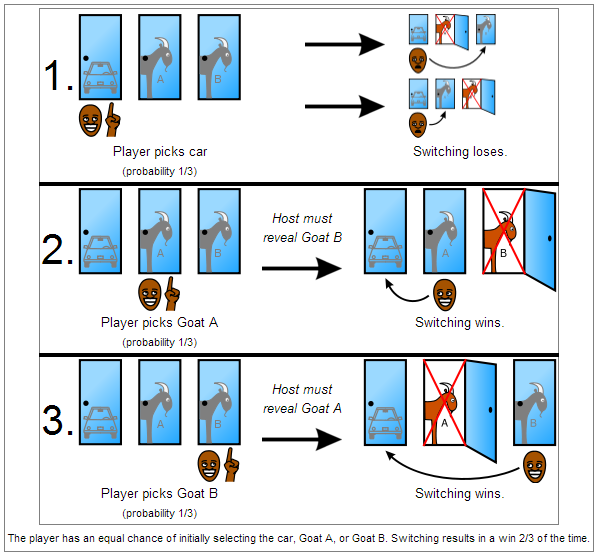
Note that there are not two possible outcomes, but three. It is important to note that there are in fact two goats in this game which makes the probability of picking the correct door drop unless switching occurs. The chart above shows the Monty Hall problem and every outcome in a nutshell. It shows each door when it is picked along with every probable outcome so long as the algorithm of always picking the other door is followed. It proves the 2/3 outcome and how it is achieved so long as doors are always switched.
With this logic, the point has been proven and the game has been learned. However, this logic to this specific problem only works if the way the game is believed to be played is true and Monty is not a liar. Any refutation that comes towards this problem can be refuted, but only if we are knowledgeable of exactly how all of the variables work. For instance, Monty could have just opened any door, and happened to never open a door with the car. What if every few games, there was no car behind any of the doors and just three goats? See what I mean, the game could be played differently. I can only base my argument off of how the game is assumed to be played, but unless i ask Monty himself, and he does not lie to me, I cannot say for certain that i know exactly how it works.
Think about it like this, we think all coin flip is a 50/50 chance only because it is believed that the coin is honest. What if it was unaware to everyone but the flipper that the coin was heads on both sides? The thought to the public is that the coin has an equal chance to land on heads or tails. To the flipper, his knows they are wrong because he has more knowledge on the situation than everyone else. He knows the chance of the coin landing on heads is 100%. The same exact situation yields two different probabilities to two different groups because of the knowledge shared and the knowledge hidden.
It should be know that chance must be random and unpredictable. The only thing there is to figure out is how probable it is for a particular event to happen. Even at that, inferences can only be made to figure out the probability on the information that is known, which is not necessarily all of the information.
Now, to make it even easier to understand, think of the same problem, but played with 100 doors. 99 of these doors contain goats while just one contains a prize. Instead of only taking one door out of play, Monty removes 98 different doors, none of which being the door with the prize. With these rules, the normal 2/3 chance from the original problem becomes a 99/100 chance. If put in this situation, the reason to switch is much clearer than it was before. This explanation could be found in this article titled “Understanding the Monty Hall Problem. As well as this, through my own experimentation using a simulator, out of 100 tests, using 100 doors, switching yielded a winning door 100% of the time.
To wrap this all up, the Monty Hall Problem is a massive counter intuitive puzzle. It is not all too easy to piece together, but once a piece of it clicks, the rest of the puzzle seems to start matching up. If we are knowledgeable about the variables and how the game is said to be played, the problem, which goes against every fiber of common sense in anybody, actually makes a lot sense.
Works Cited:
The Monty Hall Problem” Wikipedia. 21 Mach 2014. Web. March 2014.
Game Show Problem” PARADE Magazine. 1990-1991. Web. March 2014.
Understanding the Monty Hall Problem” Better Explained. 24 September 2009. web. March 2014.
“Definition of Chance.” Dictionary.com. Web. 2014.<http://dictionary.reference.com/browse/chance>


 alwaystired247
 AnonymousStudent
 azntaco
 beforeverge
 BigBabyBaller
 bitagaming
 breakingbad1820
 Caravan
 cinderella1013
 davidbdale
 Yankeelover18
 fatboy489zt
 giantsfan224
 glacierfreeze21
 gobirds17
 green0728
 gymrat230
 Gir
Gir jerseymikes1106
 jesusisking1738
 jetsfan806
 Kenneth Alex Krug
 manipulator66
 mercythyhealer14
 McCormick Karner
 mochaatrain
 oni
oni powerranger
 peanut2348
 pinkcottoncandy4
 princess01430
 redbird1123
 rubes1256
 shxrkbait
 sillyinternetperson
 soulpond47240
 spatel8267
 stingingcrib5
 tacotyphoon
 thepersonindisguise
 usmnt23
 worldofjuice999
 xephos1
 Counterintuitive Fall 2022
Professor, if you could leave feedback on this, that would be awesome!
~Vinny
Feedback provided. —DSH
P1. Vinny, please don’t alienate your readers by dividing the world into us and you. I’m interpreting your authorial attitude to be: “stumps most” means “stumps you dupes,” with the clear implication being that it doesn’t stump the author, who will now dole out some corrections to those with the wits to follow. You’re not arrogant. Don’t write arrogant. The same goes for “little to no logical reasoning” (thanks!), “most people don’t want to be told” (no, that’s NO people want to be told!) they can’t reason, and “those who believe they are right.” I will now perform the extremely difficult, but not impossible task of explaining it to the misguided among you.
Try: “what at first appears logical to all of us, including thousands of mathematicians who went on record with their opinions, turns out on closer examination to be wrong.” See how friendly? Now your readers are treated with the respect they deserve. Math pros got it wrong; no wonder we find it confusing. Thank you, Vinny, for sharing what you learned about this with us.
P2. You’re teasing too long without first setting the hook, Vinny. If you show us a glimpse of the girl first, you can then spend two paragraphs telling us about her personality before showing us more. But first we need a tantalizing glimpse. I suspect you’ll spill it in P3, but let’s back up to P1 first. What could you say there that would keep me reading all the way to P3? At the moment, I might put the paper down.
The tease: Any reasonable person would say, given the choice of two doors behind one of which is a prize, that the odds of choosing right are 50/50. But that’s not true. The Monty Hall problem is a fascinating riddle . . . .
Get me?
revised
Regrade denied. —DSH
Your revision amounts to splicing my recommendations, word for word, into your first paragraph.