
The story of Doctor Kim A. Adcock’s approach to solving a problem in the radiology department at Kaiser Permanente in Denver reads like script background for one of those “procedural” TV shows such as CSI. We know who died (far too many) and we know who did it (doctors, sort of) but we’re not sure how to handle the evidence to make sure nobody gets killed next time.
Procedures that seemed reasonable to Kaiser in 1995 because they “had always been done that way,” turned out to be entirely unreasonable, with deadly consequences. And a solution that seemed impossible because of fear, turned out to be the best and most logical of solutions, and has saved countless lives.


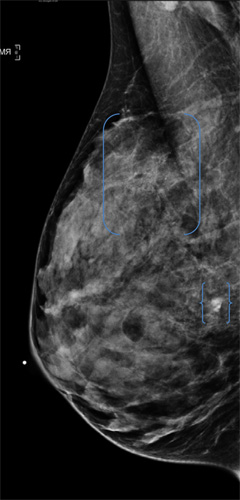
[Caption above and below:Mammography images (from 2010, left; and 2012, right) of a woman in her forties with no family history of breast cancer who missed a year of screening and in the interval developed suspicious right upper out calcifications [ ] and a suspicious mass { }, both of which underwent biopsy, yielding invasive carcinoma.]

I read this story when it first appeared in 2002 and have cherished its insights ever since. Now 12 years later, I had to go find it to share it with this class. Since reading it, and other stories like it, I cannot look at statistics of any kind without wondering what they really mean. If the crime rate goes down, does that mean there is less crime? Maybe not. It might mean fewer people are reporting crimes.
For example, in New Orleans after Katrina, distrust of the police ran so high most citizens in some neighborhoods preferred to suffer crime in silence than to involve the police. The very first thought that came to my mind listening to that story was, “I’ll bet the crime rate has gone down in those neighborhoods” and not because there’s less crime. The mayor though, and the chief of police, can trumpet those statistics as if they’re doing a better job in those same neighborhoods.
But I digress. Your assignment for THU MAR 27 is to read “Mammogram Team Learns From Its Errors,” and contribute a comment to an ongoing discussion of the counterintuitivities (I’m going to keep using this word until the rest of the world adopts it) it contains.
I don’t need an organized essay from any one of you, but I do need a contribution from everyone in the form of a comment to this post you’re reading now. I’m setting up the assignment this way to encourage you to read the entire comment string and reply to your classmates, not repeat what they’ve already said.
You may make your own original observations, of course, when you see an opportunity to point out something new. Or you may reply directly to a classmate’s observation with rebuttal or clarification. And you may contribute as well or as often as you like for a better grade. The minimum for a passing grade is one substantial comment.
Photo Source: Radiologic Society of North America RSNA
ASSIGNMENT SPECIFICS
- Follow the link from the sidebar or this link here to the article.
- Read the article looking for evidence of counterintuitivity. At what points in the story do people think or act contrary to what their intuition told them? How do you explain their feelings or thoughts? At what point in human culture does common knowledge change so that we develop different intuitions?
- Read the comments to this post that precede yours.
- If you have something new to say, add your new insight to the conversation in a comment of your own.
- If your insight is not unique, respond instead to someone else’s comment with refutation or additional support. Never repeat. Never merely agree.
GRADE DETAILS
- DUE THU MAR 27 before class.
- Customary late penalties. (0-24 hours 10%) (24-48 hours 20%) (48+ hours, 0 grade)
- Quizzes and Exercises category (10%)


 alwaystired247
 AnonymousStudent
 azntaco
 beforeverge
 BigBabyBaller
 bitagaming
 breakingbad1820
 Caravan
 cinderella1013
 davidbdale
 Yankeelover18
 fatboy489zt
 giantsfan224
 glacierfreeze21
 gobirds17
 green0728
 gymrat230
 Gir
Gir jerseymikes1106
 jesusisking1738
 jetsfan806
 Kenneth Alex Krug
 manipulator66
 mercythyhealer14
 McCormick Karner
 mochaatrain
 oni
oni powerranger
 peanut2348
 pinkcottoncandy4
 princess01430
 redbird1123
 rubes1256
 shxrkbait
 sillyinternetperson
 soulpond47240
 spatel8267
 stingingcrib5
 tacotyphoon
 thepersonindisguise
 usmnt23
 worldofjuice999
 xephos1
 Counterintuitive Fall 2022
Posting the doctors “Batting averages” of finding tumors correctly seems like a competitive way to push the doctors to have a sharper eye and hopefully save lives. However, if the patients were to ever see these results it would devastate and make the patients doubt the doctors knowledge, instead of congratulate the ones getting better. Shouldn’t missing a tumor result in being fired or a major penalty, not just lowering a number on a chart.
I agree with your first sentence, although i don’t agree with the statement after. I think it will make the patients know the doctor will work harder. The results would show that the doctor is working to improve something of their own not only clear the patients test results. We have more faith in things when they benefit the other party as well as ourselves. Missing a tumor is an awful thing but isn’t this the best way to improve their work? Firing someone for missing one tumor would result in more misdiagnoses than correct ones from fear of getting fired don’t you think?
Death is a result that is not farfetched when missing a tumor. Saying that it is okay to commonly miss tumors in test scenarios, let alone actual procedures, does not sound like the doctor i would want to go to. Even if the doctors are finding up to 80 percent of all tumors that is still a scary statistic. What if you and I are the 2 out of 10 missed? Trusting that the doctor spent a lot of time studying in their field is how i would like to think, not the best way to learn is by ones own failure.
I wouldn’t discount the importance of experience and training either, Ben, And of course, “commonly miss tumors in actual procedures” is not encouraging either. We all want to see “common failures” reassigned to less fatal positions. But if you think a surgeon does things right the first time, and doesn’t get better with practice cutting out pieces of your lung, you’re actually arguing for a worse scenario, one in which nobody improves.
I think I might agree with you, Marcus, but I’m not certain I know what you mean. I think if the whole population knew the best radiology labs were 80% effective at catching very early (they’re called nascent) tumors, they might shop for labs with better results. They might also be less inclined to skip screenings, worried that last year’s invisible problem might be a real problem by now.
I’m sure finding the lab with the best results in a reasonable distance would be their first priority. That’s the real issue is time in between screenings people should be going more so 80% is not a scary number anymore.
That depends on what’s humanly possible, I think, Ben. Missing an obvious tumor? Sure. But if 80% accuracy is truly the best human eyes can manage from black and white film with the best equipment and plenty of training and practice, then firing for a single error would empty out every lab.
The doctors are admitting that they messed up mammograms, which may cause people to refrain from getting them due to the lack of reliability.
Are you saying its better to give people a false sense of stability?
i agree, i would much rather have faith in the doctor than doubt..
I understand that this happens, Alex, but I honestly don’t understand why. I wouldn’t take an uncomfortable test that didn’t yield a productive diagnosis, but that’s a different situation. My mother was offered a full-day battery of tests to determine if her diminishing mental capabilities were caused by dementia or Alzheimer’s. “What can we do for her if it’s dementia?” I asked the doctor. “Not much.” “Well, what can we do for her if it’s Alzheimer’s?” I asked. “Not much, but it’s good to know.” I disagree. It’s useless to know.
I somewhat agree but do you think this will make a patients get different opinions from different doctors?
It’s better to admit a mistake and try to fix it than keep it quiet for pride reasons and statistical reasons, potentially killing someone. If Kaiser Permanente (the hospital) hadn’t supported Adcock in what he was doing, and decided that it would be better to keep the mistakes private in case of bad publicity, many people would have been in grave danger. It also would’ve caused a bigger stir to let an overlooked tumor go unfixed and later have it discovered that Kaiser radiologists knew the tumor was missed and didn’t do anything to fix it.
I agree, the first brave, practical, and essential step was following up on care to the patients of the incompetent film reader.
I agree with the fact that keeping errors secretive for the sake of better statistics should not outweigh the importance of the error itself, especially in this instance of misdiagnoses. Sometimes when employees’ performances are tracked, they tend to try to manipulate the system as much as possible (in this case doctors reading a minimal amount of mammograms) in order to look better than they are. However, the medical profession should be the last place to be doing that sort of thing.
“Worse still, if women knew how many cancers their doctors had missed, they might avoid mammograms altogether.”
While doctors missing noticing cancers on mammograms is upsetting, women avoiding mammograms altogether would be ridiculous. The women are afraid that they may have breast cancer but the doctors may not see it on a mammogram. However, they are more likely not to find out whether they have breast cancer if they do not go for mammograms at all. Unless, they do self breast exams and can feel a lump. Then again many women do not do self breast exams or may not do them properly. In addition, finding a lump does not necessarily mean breast cancer and the women would end up having to go to a doctor to confirm, so they might as well just go for a mammogram.
This is my feeling too, Simone. I’d rather not do regular colonoscopies, but I do them (because I’m nagged to) despite their inconvenience and the slight worry that something troubling might turn up . . . because the alternative is SO much more worrisome.
In medicine, there is an extremely small margin for mistake. Physicians go to school for more than eight years to master their specialty. However, physicians are human and mistakes are bound to be made, and that is where malpractice lawsuits surface. When Dr. Adcock wanted to weed out the weak radiologists, many felt that “malpractice lawyers would pounce.” This idea is counterintuitive. Physicians would be maliciously sued for going over films to ensure no tumors were growing and to master reviewing and analyzing X-ray. These radiologists would become the strongest in their field and the best to review mammograms.
yet they would be punished for their mistakes they are trying to fix.
It is truly counterintuitive, Taylor, but also entirely understandable. Admitting that doctors have been missing cancers does invite lawsuits. But imagine the punitive damages from knowingly retaining a doctor whose performance was demonstrably dangerous!
“Five years before, Kaiser had hired Dr. Adcock for a variety of X-ray work. He had little grounding in mammography and a cautious, statistical turn of mind not entirely common in a doctor. In fact, he had thought about becoming a lawyer, and in medicine had sought out a specialty about as far removed from patients — and especially, he says, their blood — as possible.”
———-
So Kaiser hired Adcock to work on X-Rays even though he hardly read mammograms since it was not his field of study, Being a lawyer was. Is it wrong on Adcock’s part for taking up a job he must have felt he was not experienced enough to be trusted with? In the following paragraph, it is said that “Starting out at Kaiser, he (Adcock) had dreaded missing too many tumors.” clearly he had not fully trusted himself as i stated before.
You can also spin it around and say is it wrong Kaiser looked at a paper and hired Adcock without putting him through testing towards what their “Standards” require?
Its almost more of a question as to who is to blame for this to happen, Adcock or Kaiser?
To be fair, he might have been an excellent radiographer without much mammogram experience. And he was promoted not to be the very best personal reader, but to manage a department of experienced mammographers. Personally, I’d rather have my film read by a doctor who “dreaded missing too many tumors” than by one who didn’t care. Why do you suggest Adcock “wasn’t tested,” Vinny?
I only would have guessed that he would have been tested first hand on his abilities to preform his job correctly considering the position he applied for. But it was just that, a guess
Some doctors felt that keeping track of ‘batting averages’ was an attack on their autonomy and prestige. However, if they were so prestigious they should not have to worry about their numbers as they should have little to no mistakes.
I agree that the doctors shouldn’t be worrying about mistakes with mammograms because they should have no mistakes, but maybe it’s not that they are worried but rather they feel offended that they are not trusted like they should be.
And I doubt that you think anybody “should be trusted” to make no mistakes, Angela. If they’re offended, they’re probably feeling defensive (and have mistakes to hide).
You’re right we shouldn’t be pandering to physician vanity, Simone. Also, as I’m sure you know, prestige is merely reputation, and reputation is often false.
I think the doctors should take pride in their ‘batting averages’ this could be a way to show how prestigious they are.
Most of the doctors who read breast x-rays have limited training and practice in their field which is why they keep ‘missed diagnosing” people.
“By contrast, most of the 20,000 doctors in the United States reading breast X-rays are generalists with limited training and practice in mammography.”
A specialist in reading X-Rays of mammograms should be the only person confirming if a patient does or does not have a tumor. No wonder there is so many missed tumors. A doctor with limited knowledge about tumor detection isn’t qualified to make a life changing, possibly life ending, decision.
I agree Amanda, But I do think this claim needs evidence to back it up. This is why I used a direct quote from the reading.
I’m sorry, Amanda, your claim appears to be accurate after all. Thank you, Saarah, for providing the evidence. It does seem surprising that all these years after the invention of mammography the essential job of diagnosing tumors is left to doctors with limited experience.
I don’t think “most” is fair, Amanda. The article does make me wonder why there’s so little consistency in the field though.
It’s baffling how you look up to these people to keep you safe and even yet, they still can make mistakes. Even with our current technology, there is no sure proof to find tumors and cancers. We need to rely on our doctors to do their job correctly and efficiently to make sure are not in danger. When Dr. Kaiser hired Dr. Adcock, knowing full well of his skills in his field. He should of know to double check his work to make sure he knows what he was doing. Negligence caused multiples of tumors to get screened as ok and many health risks surely followed. Doctors may not be able to be correct all the time, but they should be committed to their jobs enough to be correct most of the time. Otherwise, a reform of how people are screened must surely follow in order to keep ourselves safe.
There is no Dr. Kaiser, Ryan. Also, Adcock was hired as a department head, not necessarily for his particular expertise as a particularly accomplished film reader.
Think about just how many essential professions this applies to. Sure we trust physicians to know more, and than us, but we easily do the same with authorities, officials, and (at the risk of sounding philosophical) scientist. Many times we simply take it upon faith that these people know better than us, allowing them direct influence over our lives, and cognition.
Eventually, unless we know everything ourselves, we do have to trust somebody, don’t we, Drew? The question here is “Who is more trustworthy? The lab that gets it right 2/3 of the time but never admits it makes a mistake? Or the lab that gets it right 8 of 10 times and is open about the imperfections of the science?”
It’s baffling how you look up to these people to keep you safe and even yet, they still can make mistakes. Even with our current technology, there is no sure proof to find tumors and cancers. We need to rely on our doctors to do their job correctly and efficiently to make sure are not in danger. Dr. Adcock made it his job to improve the standards of his evaluation center personal. When he honed in on one of the doctors that had been marking positive results as negative, an alarm should have gone off in his head. He should of known to double check the doctors work to make sure he knows what he was doing. If that still doesn’t work, then a third doctor should come to check. The point I’m trying to make is that even though you can’t be right all the time, you should still try to be. Negligence caused multiples of tumors to get screened as ok and many health risks surely followed. Doctors may not be able to be correct all the time, but they should be committed to their jobs correct their mistakes and do their best to improve their craft. Otherwise, a reform of how people are screened must surely follow in order to keep ourselves safe.
~Revised
Sorry, was a bit confused when reading. I get that some times where when I read a whole lot I lose my train of thought and confuse myself with what I just read. I rewrote the comment to make more sense and it should be better. If this is still not good enough to get a b- or up, please let me know and I will fix it, thanks.
“Several states now publish individual doctors’ death rates for open-heart surgery.” By publishing the death rates of open-heart surgery for the public to see many people could loose faith in the reliability of their health care system. The missed cancer statistics along with the heart surgery statistics can stir many people into a panic. Not only will they loose faith in radiology scans but also surgeries too. Creating a statistical way to judge doctors can be a double edged sword; helping to better the doctors but scaring the patients away from them.
I agree that publishing death rates may not be very smart because it can scare away potential patients and cause people to lose faith in the health care system. The only thing that sucks is if these people are going to die anyways, they would have a better chance of living if they attempted to go through with the surgery; even if their chance of survival is only increased by say 50%.
Posting the statistics could also give people a real look at the risks involved in something. If we all believe open heart surgery is 100% safe and effective, we’ll be crushed if someone dies during it. I think it’s better to give the solid truth, as scary as it is. It prepared people and opens their eyes to the potential of the situation. A statistical method of judging doctors could also allow patients to see what hospitals to avoid when getting something done.
What differentiates open-heart surgery from mammography is that we all understand the cutting opening of the heart to be a very dangerous process conducted only on very sick people who are highly likely to die compared to healthy non-patients. Nobody expects to die from a mammogram. We also expect the doctors to find tumors if they exist. Still, it’s not the tests that kill, and often it’s not the surgery either. Cancer and heart disease do that.
Is it wrong to phrase the message in this positive way, Luke?: “Without a mammogram, the odds of finding cancer before you develop a tumor are 0 in 100; with a mammogram, your odds improve to 80 in 100.”
How are sub-par radiologists transcending med school, or even finding jobs? Missing this many tumors is frankly dangerous and horrifying meaning that our education system is allowing doctors to graduate and receive degrees in a field they are not proficient in. Kaiser and Dr. Adcock’s system is ingenious in that it roots out the bad doctors, but it is applied far too late. The Kaiser system should be implemented in institutions: Proven positive tests should be shown to students and until they reach the bear minimum number of correct diagnosis, they should incapable of graduating. Teaching the necessary skills to find tumors in schools would prevent job loss in a medical community desperately in need of quality radiologists.
They acquire jobs because they perform well on tests, which does not compare to real-world examples. It is very easy to ace a test, because there is no risk factor. But actual mammograms are not specifically designed to look like a certain problem; they are too individualized to make a half-baked diagnosis on.
You’re probably right, Rachel. I wouldn’t trust the ability of a radiologist who had only practiced in a classroom setting.
That sounds like a fantastic idea, but only for doctor candidates who are actually headed into radiology. Keeping a psychiatrist from graduating medical school because of a lack of technical diagnostic skills would be counterproductive. Maybe once they’re hired as radiologists, film readers should be only the “first readers” on film, backed up by senior staff, until they achieve the skill level of the best readers?
It may not seem obvious to many people but being a doctor isn’t just about saving lives; there is also politics attached to the job. Medical politics takes place not only on the government level but also within the establishment themselves. From the governmental standpoint “regulating doctors prove[s] too politically risky.” Revealing the statistical success per failures may cause the people to lose trust in a system which for better or worse is all that we have. When looking at the politics that takes place among the hospital staff and the medical institutions, it is not surprising that more measures have not been taken to produce better results. Many doctors fear a malpractice lawsuit so therefore some will go to great lengths to bury their mistakes and not bring them to the light if it could mean improving the life a patient.
That’s just the battle Adcock had to fight, isn’t it, Casmir? I’m surprised he was able to prevail against the institutional resistance to openness and transparency. Nobody likes to confront his own errors, but when ignoring them costs lives, admitting them is essential. Understanding the reluctance of institutions (or just local service companies) to be open about their performance records is what makes “consumer-rating” services like Angie’s List so popular, isn’t it? We feel better if we get reviews from satisfied and dissatisfied customers (or patients) alike.
I agree that it is vital for physicians to recognize their mistakes and strive to improve them. On the other hand, from my experience in volunteering at Kennedy Hospital, most doctors will emphasize “ignorance is bliss” when it comes to their patients. By advertising their successes over their failures it allows for the constant positive affirmation in our medical institutions. Now, that being said, the medical staff at Kennedy is excellent but when they do falter they surely do not go around advertising it. My point is, when it comes to medical institutions we are aware that some may be better than others, but when can never truly have a concise measurement of who the best are.
Though the doctors may not have caught it at first, the ability to go back and look over mistakes could make people trust more in the hospital because instead of worrying about lawsuits they were worried about health. Also, consider all the other hospitals that haven’t gone back and checked mistakes…how would we know if other hospitals didn’t have even more mess-ups but never cared enough to go back and check?
I agree, Angela. Now, if only there existed a system that made it easier for hospitals to track their results. In too many cases, the same patient doesn’t return to the same lab for repeat readings, making it impossible to compare films from earlier years with films from later years.
I agree, it’s scary to think that some places never went back to double check things, especially with something as serious as this.
“After the surgeons’ scores began appearing, the heart-surgery death rate had fallen by about 40 percent.”
The fact that surgeon’s were under performing because their statistics weren’t public knowledge is almost incomprehensible to me. On top of that, the death rate didn’t drop five percent or ten percent, it dropped forty percent. When an individual enters a dangerous and costly procedure like heart surgery, the last thing he is thinking is whether or not the doctor is going to be really trying his best. He would expect the best. People’s lives were literally put into these surgeon’s hands and lost because the surgeons didn’t fully perform on the surgery. The surgeons clearly cared about what others thought about them so much that decided to fully try when their reputation was on the line. I can’t help but compare this to games where you keep score, except the stakes were quite a bit higher. The only way our intuition would ever change to account for absurdities like this is if we started having a much more cynical outlook on life.
According to the American Heart Association heart surgery increases the death rate in cancer survivors who have had radiation to treat their cancer. If the scores of radiologists become available to the public, many women might just feel discouraged to get a mammogram due to the pricing and fact that they are not completely accurate. Work in progress
The decrease of heart surgery deaths may be attributed to the fact that more women are getting discouraged to get mammograms due to their price, inaccuracy, and even the health risks that follow up procedures pose to treat tumors which in many cases prove fatal. With less women getting mammograms and being treated for tumors, the heart surgery death rate would obviously go down, however not because doctors are identifying more tumors but because less women are being treated and dying due to complications.
Undoubtedly some women avoid mammograms out of fear that cancer will be discovered. They’d rather not know they have a life-threatening illness if ignorance means they can enjoy their lives in denial until the reality is unavoidable.
I see that you’re still working on this comment, Josue. I’m not sure what it means yet. Maybe it means radiation to treat cancer damages the heart, making heart surgery more likely necessary. Patients may be dying from heart disease, not heart surgery.
I like this paradox about counterintuitivity, John. It may be a function of maturity (or more cynically, a function of simple aging) that our more senior observers are no longer surprised to find that everybody’s a buffoon about half the time. Our intuitions do change over time. I’m glad that the situations that still strike me as counterintuitive are the negative outcomes in life. When I start being surprised about things going right (I get closer all the time), the world will seem very depressing indeed.
The firing of Dr. Walsh seemed both fair and unfair. It seemed unfair because he had been there for years, and was 60 with a family and kids. He was fired after it was claimed that he had failed to read tumors too many times. However, it did seem fair, because at least three misreads were trailed back to him. Out of 259 women brought back, 10 actually had cancers. 3/10 is a large ratio of the misreads. However, this led to Dr. Walsh taking extra care into his future readings, and being a fill-in reader for other states, while also causing other doctors to be more careful with their own readings, for the fear of being next to be fired. Dr. Wiesenthal claims ‘We didn’t take any action until it was patently clear that he didn’t do this very well.’ Although Dr. Walsh felt singled out. I believe that the actions taken were fair, although to Dr. Walsh the actions were painful and devastating.
Sadly, Walsh doesn’t appear willing to admit this, and we can understand why. He clings to the claim that “I was right.” Sadly too the data aren’t always conclusive. “You should have seen that this smudge might someday develop into a tumor” might be an easy accusation to make, but a very hard standard to live up to, even impossible. That’s why it’s better to admit that the science is very good, and our best prognostic tool, but no guarantee of accurate predictions.
I agree with the firing of Dr. Walsh even though it seemed unfair to an extent. His job is to save lives of patients who are relying on him and when he fails to do that, he should be fired. I felt bad for him considering he was 60 with a family and kids in college but I also believe the right decision was made to fire him.
Some doctors read about 14,000 mammograms a year which means they are subject to make more mistakes than a person reading fewer. When Dr. Adcock implemented counting how many tumors were missed in mammograms many doctors started reading fewer in order to save their jobs. Many were abiding by the federal law of reading 480 a year which is crazy that some doctors were more worried about their jobs than actually saving lives. Doctor Adcock assumed that these doctors were not as skilled as the ones reading more mammograms and restricted them to reading CAT sans. This is a flaw in his practice because although the doctors that didn’t read many mammograms could still be good doctors but are just scared of losing their job.
I read this part very differently, Erik. I didn’t get the impression that anybody reduced the number of readings at all, only that some readers, whose job was not primarily the reading of film, never had read enough to be statistically conclusive. What you say is certainly true, reassigning those doctors who read fewer than the minimum might have cost the hospital some good readers. But I didn’t see evidence that they stopped reading more film out of fear.
“Even today, Kaiser is reluctant to advertise its turnaround, and it would share only some data with The Times. Too many people still believe doctors walk on water, one official explained, so how can we brag about making fewer mistakes?”
This is counterintuitive in the aspect of the hospital can’t even post how much they have improved because people will still only focus on how they messed up in the first place.
I totally agree. Plus the hospitals are automatically at a disadvantage because people expect them to be perfect. Even when hospitals improve, they still do not meet everyone’s expectations.
While everyone does expect perfect from doctors when presented with the numbers showing how much they have improved can the public really stay that mad. I agree that a large of a number of the public see doctors as perfect which they shouldn’t because they are only human too
Doctors are put in a difficult position because they have other people’s lives in their hands and I totally sympathize with them and commend them for having the courage and the drive to pursue that career. Unfortunately people do stay mad at them as seen by malpractice lawsuits filed against some. Thank gosh for malpractice insurance.
I agree with you three. People shouldn’t get so mad at mistakes. The career itself is hard, and reading the films are known to be one of the hardest things to do within the career. At least (it seems like) doctors are trying to help people by making attempts at catching cancers instead of not running any scans at all. No human is perfect.
That’s completely true people expect hospitals to be clean and perfect all the time when that’s where we go when were diseased and broken.
Hospitals are advertised as a place where lives are saved, which is true, but there is always the other side of the story. Not everyone can be helped but hospitals direct the positive stories to the public. So if the press is already focusing on the problems of this specific hospital they are going to disregard the positive things that they’ve done because of the problems they have had.
Huh. That’s what I just said, Simone. 🙂 You got here first.
Weird, right? The situation seems to be that we have always held doctors and hospitals to an impossible standard: the care has always been and must be error-free.
“Don’t put too much faith in a doctor being board certified in radiology. Many doctors passed before the late 1980’s, when mammography was added to the exam. In any case, the number of practice mammograms on the test does not reflect the rigors of real-world screening.”
It would make sense to not trust older doctors because they might not have enough experience with reading mammograms. But even younger doctors with plenty of experience still make mistakes in their readings. A doctor’s credibility should not be based on age, unless they continue to foster obsolete beliefs. Perhaps doctors should be routinely tested on their knowledge, because information has the capacity to change.
Other than the “normal” job of a physician, the second and extremely important job of a physician is to continue their education. It could be reading or attending conferences. Age, therefore is not a huge factor, as long as physicians continue to learn as information changes.
Quality of work is much different from age. Although older doctors may have had more time to expand their education, a younger doctor may have already put enough effort to surpass any older doctors or may be better at their career. Quality is always better, and age shouldn’t be a factor.
Maybe we’re wrong to call contrary results “mistakes.” Suppose I am asked to predict an earthquake, but the best science in the world can only offer a percentage of likelihood, not certainty. If I say the odds of an earthquake in the next three months is 30%, and an earthquake occurs, did I make a mistake? No. Conversely, if I cite odds of 90% and no earthquake occurs, is that a mistake? No. The only way to improve the odds of catching every future tumor would be to biopsy every woman whose film showed the slightest chance of cancer developing. We can have that system if we want it, but a biopsy every couple of years would most likely discourage far more women from mammograms than anything else we could do.
“Dr. Ken Heilbrunn, a Seattle radiologist who says he admires what Dr. Adcock has done, calls this the ”shame” factor, and manipulating it is the stealth ingredient of the Kaiser method. ”To really improve your skills,” he explains, ”you have to repeat this shameful moment over and over.” ‘
Even after all of the schooling and licensing to become a physician, medical education is never completed. It is an understood fact that physicians still need to further their education, for example by reading medical journals and magazines and attending seminars to keep up with modern technology and medical discoveries. By having radiologists review X-ray films, this is a form of continuing their education and grow in their specialty. Physicans must continue to improve their skills, as Dr. Heilbrunn states above.
Nicely said, Taylor.
I agree that physicians are humans. However if they are not a hundred percent sure about their findings maybe they should ask the patient to do another mammogram. So they can avoid misdiagnosing the patient.
This is a good point! I also think it would be a good idea to get a second pair of eyes to look at the results of the mammogram. Therefore, if the first doctor did miss something the second doctor would catch it.
Yes, doctors are humans. Everyone makes a mistake eventually, especially if they “obsess” over a certain type of look in their mammograms, or are “out of the zone.” Sometimes the images are unclear too. However, I agree that another mammogram may help misdiagnosing patients, or maybe having another member of the team weigh in their opinion.
You’re right and I think they probably do on tough cases, Lashawn, Saarah, and Stephen. Remember Adcock’s anecdote about how many films he kept dumping into the “unsure” pile? (Stephen’s comment refers to this section.) Those would have to have been read by another doctor. I think the “failure” rates are based on films for which a doctor didn’t ask for a second reading.
Dr. Addock producing this “Batting Averages” help the radiologist working under him to not become relaxed in their position. When deciding to become a radiologist you sign on to become some sort of a “life saver” and this can not be taken lightly.
For doctor that have only had minimal practice in reading X-ray scans is horrifying for me. A doctor could have become board certified over 20 years ago and has limited training and practice in mammography. Technology has changed and cancer looks different for everyone. I believe that their should be a number of correctly read x-rays per year for a doctor to be certified every year. This re-certification program practitioners curb their mistakes and over looks. As Dr. Addock explained this is about separating emotions from the quality of their work.
My only reaction is that I hope there’s still room in any health care system for “generalists.” We can’t completely compartmentalize medicine, trusting only the single-issue specialists to do one job extremely well. The body’s too complex for that, too many systems are interdependent. We need doctors who see the whole picture too, not just the tiny smudges on the small picture.
I agree with your statement because I could only imagine how scary it would be for someone to have their X-rays misread. That could alter a person’s state of mind
Doctor’s are constantly battling life threatening illness and it’s absurd to think that such a serious job can be “taken lightly.” As technology advances so should our doctors, its counter-intuitive to have technology that people can’t utilize properly. Doctors should constantly be made to learn about the latest tech and have to be re-certified every few years.
Tracking the performances of doctors seems like an excellent way to see those who are working adequately, and those who are not. However, the only issue that comes up is the way in which this system deals with under-performing doctors. In the case of Dr. Walsh, a doctor who was found to have recorded 3 cancer misdiagnoses, Kaiser did not hesitate to fire him for his rather large amount of errors. Had Kaiser kept him after he was informed of his mistakes and given him a “probationary” period per say, it would be likely that he would be much more alert and motivated to better do his job, which would result in less misdiagnoses. In fact, the article states that Walsh did go on to attend training programs and start reading mammograms as a fill-in radiologist in other states, noting that his medical staff encountered no issues with his work. Instead of immediately trying to root out the “bad” doctors, why not give them a chance to save their jobs by using their past mistakes to motivate them.
That’s certainly reasonable of you, Ryan. I wonder if the explanation can be found in Walsh’s attitude years later that “I was right and they were wrong.” Rather than admit to errors, he seems to have dug in and resisted. Adcock and Kaiser may have canned him because he didn’t accept the need for change and further training. If he learned that lesson elsewhere, that’s good.