
How Much is Equitable?
Rocky the Mountain Lion, Denver Nuggets’ mascot, has an annual salary of $625,000, while the highest paid WNBA player, Breanna Stewart, earns $228,094 a year. Many people, especially women in sports, tend to look at the numbers and think that these numbers are completely unfair because the women spend years of their lives dedicated to their sport to receive little to no money compared to other professional athletes. However, the problem does not surround hours spent in the gym. The problem starts with how accessible the WNBA is to consumers. If audiences had access to the WNBA games as much as NBA games, generating more advertising revenue, then women in professional basketball would get paid the same percentage of revenue as men in professional basketball.
The most common misconception in the argument between salary in mens and womens sports, especially the NBA and WNBA, is the difference between equality and equity. As words that sound similar, they are often confused. According to Oxford Languages, equality is defined as “the state of being equal, especially in status, rights, and opportunities,” or “a symbolic expression of the fact that two quantities are equal; an equation.” If we follow these definitions closely, both NBA and WNBA players would receive the same salary. The money would be divided up evenly among each player. The idea of equal pay in sports, especially through two leagues that host different levels of competition, is not plausible. What is needed is equity.
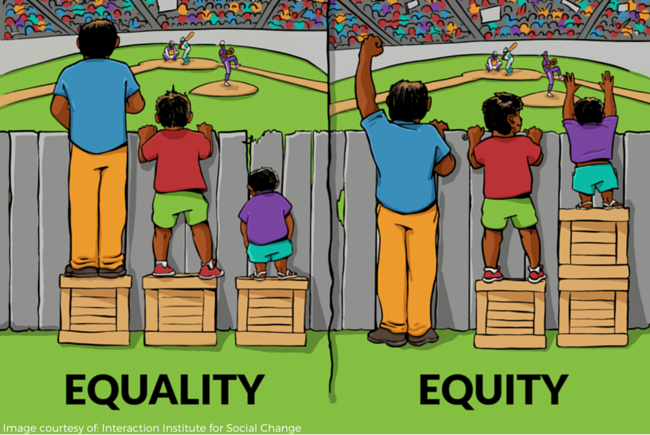
Equity, by definition, is the quality of being fair and impartial. Although equity and equality may sound similar, equity is the act of providing what is needed to each person, not necessarily the same thing that is given to everyone. The struggle with equity goes beyond pay in sports, as even women professional athletes are denied the opportunity to compete at the same capacity as men. There are many movements, including the Equity Project, that focus on promoting equitable play and pay for women all over. In order to achieve equitable pay, the focus should be on revenue and accessibility for the audiences.
One of the largest influences on salary in athletics is revenue. Revenue is the money that a sport organization brings in as a result of selling products and services. In the NBA’s collective bargaining agreement (CBA) it is noted that the players receive a percentage of revenue shared. In an article provided by cbabreakdown.com, it is noted that the NBA receives a Salary Cap, which is affected by basketball-related income (BRI) and the current number of NBA teams. The WNBA does not have the same CBA, but has the opportunity to renegotiate or opt out of their ludicrous agreement that restricts them from receiving compensation from their own name will be coming in just a few short years.
When diving into the differences between the NBA and the WNBA’s BRI, one of the biggest holes seen is the variety of factors that fuel what percentage of revenue the women get. Kelsey Plum, 5’8” guard for the Las Vegas Aces, recently sparked interest in the conversation on The Residency Podcast. In Plum’s interview, she shines a spotlight on the CBAs that both the WNBA and NBA have. Plum shocks listeners by informing them that she does not receive a dime off of her own jersey sales or when her name is used in an ad, while players like LeBron James receive compensation for jersey sales or television contracts.
Any form of media, especially television, are the driving force behind salary in sports. Whether athletes are seen in 30 second commercials or their games are displayed on television, it is a way to promote themselves and their brand. Coverage is crucial. In a roughly 25-year study, researchers from the Amateur Athletic Foundation of Los Angeles (now LA84) and the University of Southern California’s Center for Feminist Research combined for five larger reports, four of which came from LA84 (1990, 1994, 2000, 2005) and the most recent from USC (2010). The study focused on the “coverage of live televised sports events, print, online, social, and televised news media coverage of sports as well as the implications of media coverage for women’s sports.”
In an unrelated study, Andrew Billings and Brittany Young found that SportsCenter and Fox Sports Live featured women’s sports coverage less than 1% of the time. The lack of coverage on some of the most watched media conveys the message that “women’s sport is less important, less exciting, and, therefore, less valued than men’s sports.”
Cheryl Cooky, Michael Messner, and Michela Musto decided to do a 5-year update to the previous 25-year study. In 2014, they decided to reiterate the study. Cooky, Messner, and Musto found that none of the news and highlights shows (primarily KNBC, KCBS, KABC, ESPN, and Fox Sports) that they studied lead with a story about women’s sports. Researchers also discovered that “even with broadcast time constraints, networks do find time to include frequent “human interest” stories on men’s sports.” One example of where this appeared was found that:
KNBC’s March 18, 6 p.m. sports news included a 30-s segment about a swarm of bees invading a Red Sox versus Yankees game and a 20-s segment about an 18-in. corn dog available for purchase for US$25 at the Arizona Diamondbacks stadium
On the same broadcast, there was no mention of women’s sports. As previously iterated, coverage is crucial.
In order for these women to get their name out to the world, they need to be seen. In order for these women to promote their salary, the world needs to be exposed to them. While equal pay is not plausible, equitable compensation is. Women in professional basketball, and sports in general, need to be represented to a larger extent in order to receive preferable remuneration.
References
Cooky, C., Messner, M. A., & Musto, M. (2015, June 5). “it’s dude time!”: A quarter century of excluding women’s sports in … “It’s Dude Time!”: A Quarter Century of Excluding Women’s Sports in Televised News and Highlight Shows. Retrieved October 18, 2022, from https://journals.sagepub.com/doi/full/10.1177/2167479515588761
Salary Cap Overview, CBA Breakdown, 2022, https://cbabreakdown.com/salary-cap-overview.
The Equity Project, Women’s Sports Foundation, 2022, https://www.womenssportsfoundation.org/the-equity-project/
Tomastik, J., Raven, L., & Belcher, D. (Hosts). (2022, November 23). Kelsey Plum Exposes How Underpaid WNBA Players Really Are!! (No. 122) [Audio podcast episode]. In The Residency Podcast. PodBean. https://theresidencypod.podbean.com/e/ep-122-kelsey-plum-exposes-how-underpaid-wnba-players-really-are/


 alwaystired247
 AnonymousStudent
 azntaco
 beforeverge
 BigBabyBaller
 bitagaming
 breakingbad1820
 Caravan
 cinderella1013
 davidbdale
 Yankeelover18
 fatboy489zt
 giantsfan224
 glacierfreeze21
 gobirds17
 green0728
 gymrat230
 Gir
Gir jerseymikes1106
 jesusisking1738
 jetsfan806
 Kenneth Alex Krug
 manipulator66
 mercythyhealer14
 McCormick Karner
 mochaatrain
 oni
oni powerranger
 peanut2348
 pinkcottoncandy4
 princess01430
 redbird1123
 rubes1256
 shxrkbait
 sillyinternetperson
 soulpond47240
 spatel8267
 stingingcrib5
 tacotyphoon
 thepersonindisguise
 usmnt23
 worldofjuice999
 xephos1
 Counterintuitive Fall 2022
Holly, it’s too late for an exhaustive critique of an essay that was due months ago, but I’m happy to see the post, and I will make at least one comment per paragraph.
Rocky the Mountain Lion, Denver Nuggets’ mascot, has an annual salary of $625,000, while the highest paid WNBA player, Breanna Stewart, earns $228,094 a year. Many people, especially women in sports, tend to look at the numbers and think that these numbers are completely unfair because the women spend years of their lives dedicated to their sport to receive little to no money compared to other professional athletes. However, the problem does not surround hours spent in the gym. The problem starts with how accessible the WNBA is to consumers. If audiences had access to the WNBA games as much as NBA games, generating more advertising revenue, then women in professional basketball would get paid the same percentage of revenue as men in professional basketball.
—Rocky is a very good anecdotal bit of evidence, but you can’t call his $625,000 a “salary.” Mascots like Rocky and the Phanatic make most of their money off of paid public appearances. Also, Rocky makes about 10x what an average NBA mascot makes.
—We’d like to agree with your premise, but instead of the claim you make, a more accurate claim might be: “If the WNBA earned as much revenue as the NBA, and if the WNBA players’ CBA were as generous as the NBA’s, THEN, women would be paid equally.”
The most common misconception in the argument between salary in [men’s] and [women’s] sports, especially the NBA and WNBA, is the difference between equality and equity. As words that sound similar, they are often confused. According to Oxford Languages, equality is defined as “the state of being equal, especially in status, rights, and opportunities,” or “a symbolic expression of the fact that two quantities are equal; an equation.” If we follow these definitions closely, both NBA and WNBA players would receive the same salary. The money would be divided up evenly among each player. The idea of equal pay in sports, especially through two leagues that host different levels of competition, is not plausible. What is needed is equity.
—You let the dictionary define “equality,” which is the opposite of what a Definition Argument is supposed to do. YOU are in charge of how the words are used in YOUR arguments.
—The second definition “the equation” one, is completely irrelevant.
—You don’t go far enough. Equality in pay would mean EVERY PLAYER RECEIVES THE SAME SALARY. You might mean that, but you don’t quite say it.
Equity, by definition, is the quality of being fair and impartial. Although equity and equality may sound similar, equity is the act of providing what is needed to each person, not necessarily the same thing that is given to everyone. The struggle with equity goes beyond pay in sports, as even women professional athletes are denied the opportunity to compete at the same capacity as men. There are many movements, including the Equity Project, that focus on promoting equitable play and pay for women all over. In order to achieve equitable pay, the focus should be on revenue and accessibility for the audiences.
—”What is needed to each person” is certainly not what you really want.
—If you did, a rich player might not get paid at all, while a player who went bankrupt during the previous season and had 12 dependents might NEED 10x what another player NEEDED, regardless of their value to the team.
One of the largest influences on salary in athletics is revenue. Revenue is the money that a sport organization brings in as a result of selling products and services. In the NBA’s collective bargaining agreement (CBA) it is noted that the players receive a percentage of revenue shared. In an article provided by cbabreakdown.com, it is noted that the NBA receives a Salary Cap, which is affected by basketball-related income (BRI) and the current number of NBA teams. The WNBA does not have the same CBA, but has the opportunity to renegotiate or opt out of their ludicrous agreement that restricts them from receiving compensation from their own name will be coming in just a few short years.
—This paragraph is REALLY apples and oranges.
—You start by mentioning the NBA players receive “a percentage of revenue shared,” which is amazingly vague.
—Then you mention the NBA salary cap, which limits how much teams can spend on players.
—Then, without making a comparison to either, you mention that WNBA players can’t license their own names or images (which would apply to NEITHER revenue sharing nor salary caps).
When diving into the differences between the NBA and the WNBA’s BRI, one of the biggest holes seen is the variety of factors that fuel what percentage of revenue the women get. Kelsey Plum, 5’8” guard for the Las Vegas Aces, recently sparked interest in the conversation on The Residency Podcast. In Plum’s interview, she shines a spotlight on the CBAs that both the WNBA and NBA have. Plum shocks listeners by informing them that she does not receive a dime off of her own jersey sales or when her name is used in an ad, while players like LeBron James receive compensation for jersey sales or television contracts.
—This is the first direct comparison, and an important one.
—But the real benefit of licensing their own names won’t be solved by the teams. It will only be truly profitable when their names are made famous by media exposure. Be careful who you blame.
Any form of media, especially television, are the driving force behind salary in sports. Whether athletes are seen in 30 second commercials or their games are displayed on television, it is a way to promote themselves and their brand. Coverage is crucial. In a roughly 25-year study, researchers from the Amateur Athletic Foundation of Los Angeles (now LA84) and the University of Southern California’s Center for Feminist Research combined for five larger reports, four of which came from LA84 (1990, 1994, 2000, 2005) and the most recent from USC (2010). The study focused on the “coverage of live televised sports events, print, online, social, and televised news media coverage of sports as well as the implications of media coverage for women’s sports.”
—This sounded as if it were going somewhere, but after a long buildup, you don’t reveal ANYTHING about the study results.
In an unrelated study, Andrew Billings and Brittany Young found that SportsCenter and Fox Sports Live featured women’s sports coverage less than 1% of the time. The lack of coverage on some of the most watched media conveys the message that “women’s sport is less important, less exciting, and, therefore, less valued than men’s sports.”
Cheryl Cooky, Michael Messner, and Michela Musto decided to do a 5-year update to the previous 25-year study. In 2014, they decided to reiterate the study. Cooky, Messner, and Musto found that none of the news and highlights shows (primarily KNBC, KCBS, KABC, ESPN, and Fox Sports) that they studied lead with a story about women’s sports. Researchers also discovered that “even with broadcast time constraints, networks do find time to include frequent “human interest” stories on men’s sports.” One example of where this appeared was found that:
KNBC’s March 18, 6 p.m. sports news included a 30-s segment about a swarm of bees invading a Red Sox versus Yankees game and a 20-s segment about an 18-in. corn dog available for purchase for US$25 at the Arizona Diamondbacks stadium
On the same broadcast, there was no mention of women’s sports. As previously iterated, coverage is crucial.
—This is a clever anecdote that places the blame for underexposure of women’s sports on the primary sports media.
—Now, to be fair, all media are happy to air ANYTHING that gets viewers. You have to be willing to make the case that IF they started to air WNBA games more often in better time slots, VIEWERS would compel the networks to air more games, generate more ad revenue, etc., etc.
In order for these women to get their name out to the world, they need to be seen. In order for these women to promote their salary, the world needs to be exposed to them. While equal pay is not plausible, equitable compensation is. Women in professional basketball, and sports in general, need to be represented to a larger extent in order to receive preferable remuneration.
—Sure.
—Professional table tennis players could make the same argument. “We can’t get on TV; that’s why we can’t make a living playing ping-pong.”
—How do you answer that challenge?
This is a credible first draft, HollyP. We could make something quite good out of it if we had several weeks to swap feedback and revisions.
Provisionally graded. You may not get another round of feedback (almost certainly you will not), but you can get a Regrade following substantial Revision. Don’t forget to put this back into Feedback Please.
Why is this back in Feedback Please, Holly? Are there revisions coming?
I revised the points you had made and forgot to leave a comment noting that I made those changes. I apologize.