
Background: The author of this blog explains the “Three Prisoner’s Problem.” Three prisoners are jailed and two are to be executed at random. The warden is the only person who knows who walks. Prisoner A asked the warden if he would tell him the name of at least one other prisoner who was to be executed. The warden responds with Prisoner B. Prisoner A tells Prisoner C what he found out and Prisoner C realized that he now has a 2/3 chance at survival, while Prisoner A is left with a 1/3 chance.
How I Intend to Use it: Although a different premise is introduced, this problem is the same exact thing as the Monty hall problem. If the first explanation of the problem leaves the reader confused, I believe relating it to this second problem may help. It gives both problems a base for each other to stand on. This could have made it easier for the reader to grasp the premise and understand the solution to the problem introduced as my counterintuitive topic.
Background: Despite coming from Wikipedia, this entry explains a mathematical theory knows as Bayes’ Theorem. Bayes’ Theorem is essentially the mathematical equation explaining how the Monty Hall problem works. The theorem looks like this:
P[A|B] = {P[B|A]P[A]}/P[B] = {P[B|A]P[A]}/P[B|A]P[A]+P[B|C]P[C]
Basically, the odds start at 1:1:1. Lets say the contestant picks door A and Monty opens door C. The ratio changes to 1:2:0. Now, given the option to switch to door B, it would be wise for the contestant to take it since the ratio shows it has the highest chance of containing the car.
Bayes’ Theorem is the explanation behind the problem.
How I Intended to Use it: Up to this point, I have explained why the problem works the way it does. With Bayes’ Theorem, I can show why this is how it works. Bayes’ Theorem is the foundation to the understanding of the problem.
Background: The author of this article touches on the Monty Hall problem. Supposed the contestant picks door A, which is the door that the car is behind. If doors are switched, loss is certain. However, if the contestant picked door B, the 1 goat would be revealed and if she switched, she would win the car. Same goes for door C. when looking at it this way, you have a 2/3 chance to win as well.
How I Intended to Use it: The article gives a second reason to why Monty Hall problem works the way it does. It is not nearly as in depth as the others, but it does offer another way to look at the solution. It lays out each and every situation the contestant could be faced with. In the end, out of the three situations, the contestant would only lose one time and would win the other two providing she switched. I will use this information to introduce another way of looking at the solution to the problem by mapping it out rather than explaining the probability.
“Marilyn Vos Savant – Game Show Problem”
Background: Marilyn shows her timeline of the battle with the public on the logic of this problem. In this, Marilyn shows everyone against he logic and the comments they made, while also explaining the logic herself. She also gives examples and experiments which test the hypothesis that switching wins more. This article clarifies the base argument that swapping to the side with more doors is beneficial.
How I Intended to Use it: This article provides all the base to my topic. It explains the background of how the problem came to be and where the idea came from. It also states the exact original problem as asked by somebody. Savant provides the solution of why the problem works the way it does in great detail. she even provides an experiment for readers to try and invites them to report back to her.
“Understanding the Monty Hall Problem”
Background: This article provides not only a simulation to work with, but also another example to better understand why switching doors is better. this example contains the same problem, but uses 100 doors rather than 3.
How I Intended to Use it: In this article, the author explains the problem with a slight twist. Say that instead of three doors, there are 100. the contestant picks one, and Monty opens up 98/99 of the doors the contestant had not picked. Think the contestant would start feeling the pressure if he did not switch? It is the same exact problem as the un-altered version, but it emphasizes the purpose of switching doors, and I would like to use that as a good example of why to switch
“Monty Hall Problem Simulation”
Background: This website is nothing more than a simulation of the problem itself. It lets the visitor play the game and realize how and why it works.
How I Intended to Use it: I conducted my own 1st hand research on the problem with this simulator. I came up with the following numbers which i planned on using in my paper:
statistics out of 200:
traditional, Always switch doors:
Wins: 125
Losses: 75
Win %: 62.50
Statistics out of 100:
out of 100 doors, Always switch doors:
wins: 100
Losses: 0
Win %: 100.00%
traditional, never switch:
Wins: 34
Losses: 66
Win %: 34.00
Traditional, switch half of the time:
Wins: 50
Losses: 50
Win %: 50.00
“Monty Hall Problem (Wikipedia)”
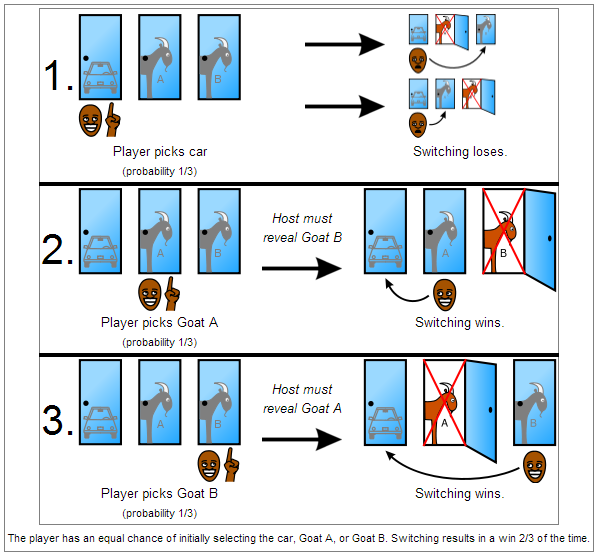
Background: This Wikipedia page explains everything that has to do with the Monty Hall Problem. It talks about various different ways to go about the problem using charts and explanation.
How I Intended to Use it: Considering this is a Wikipedia page, i intended to use none of the information. Rather, i took a chart from this page to include in my paper. This one to be exact:
“The Monty Hall Problem – Lets Make A Deal”
Background: On the official Lets Make A Deal website, the Monty Hall Problem is discussed. It also talks about places it has been published or show, such as TV shows, movies, books, articles, papers, ect. It brings up Marilyn vos Savant again, as the one who started and solved the controversy.
How I Intended to Use it: This webpage offers many examples of the problem in various books. One example is “The Curious Incident of The Dog in The Night-Time” by Mark Haddon. In his book, Haddon states a formula which could be used for explaining the math of the Monty Hall problem. It goes like this:
—
Let the doors be called X, Y and Z.
Let Cx be the event that the car is behind door X and so on.
Let Hx be the event that the host opens door X and so on.
Supposing that you choose door X, the possibility that you win a car if you then switch your choice is given by the following formula
P(Hz ^ Cy) + P(Hy ^ Cz)
= P(Cy)  P(Hz
P(Hz  Cy) + P(Cz) P(Hy Cz)
= (1/3 1) + (1/3 1) = 2/3
—
I ended up not using this in order to not confuse my reader even more.
Background: Both of these clips are the Monty Hall Problem represented on the screen. 1st in the TV show Numb3rs, then in the movie 21. Both are set in a classroom with the teacher teaching their students the problem. In the end, in a span of about two minutes, both clips explain the problem to their students as well as the viewers beautifully.
How I Intended to Use it: The clips are good, CONCISE, examples of the problem. Both are short, sweet, and to the point. Since they are meant to be seen by people who have most likely never heard of the problem, the writers had to be concise to keep a viewers interest while explaining the problem in its entirety. This helped me with my definition of the problem itself.
Background: On Drexel University’s math forum, they go into detail about some probability mechanics at work in the Monty Hall problem, specifically, sample space. Sample Space is a set of all possible outcomes for a certain problem. No matter what the outcome, it is listed on the sample space.
How I Intended to Use it: In the Monty Hall Problem, the sample space is car, goat 1, and goat 2. That’s important! When looking at the problem, most would say you either walk away with just a car or a goat. Wrong! It is important to realize that there are three possible outcomes because that helps to explain the probability end of the problem.
I ended up not including this simply because i was able to explain this without needing to throw the term sample space into my paper.


 alwaystired247
 AnonymousStudent
 azntaco
 beforeverge
 BigBabyBaller
 bitagaming
 breakingbad1820
 Caravan
 cinderella1013
 davidbdale
 Yankeelover18
 fatboy489zt
 giantsfan224
 glacierfreeze21
 gobirds17
 green0728
 gymrat230
 Gir
Gir jerseymikes1106
 jesusisking1738
 jetsfan806
 Kenneth Alex Krug
 manipulator66
 mercythyhealer14
 McCormick Karner
 mochaatrain
 oni
oni powerranger
 peanut2348
 pinkcottoncandy4
 princess01430
 redbird1123
 rubes1256
 shxrkbait
 sillyinternetperson
 soulpond47240
 spatel8267
 stingingcrib5
 tacotyphoon
 thepersonindisguise
 usmnt23
 worldofjuice999
 xephos1
 Counterintuitive Fall 2022